Back

Primary Structure of Nucleic Acids definitions

Control buttons has been changed to "navigation" mode.
1/12
  • Primary Structure

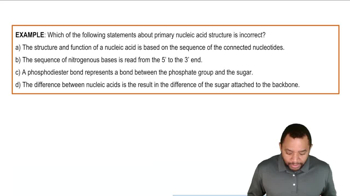
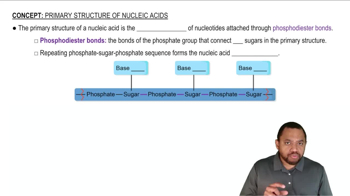
    Sequence of nucleotides in a nucleic acid chain, connected by phosphodiester bonds, determining genetic information.
  • Nucleotide

    Building block of nucleic acids, consisting of a phosphate group, a pentose sugar, and a nitrogenous base.
  • Phosphodiester Bond

    Covalent linkage joining the phosphate group of one nucleotide to the sugar of another, forming the backbone.
  • Phosphate Group

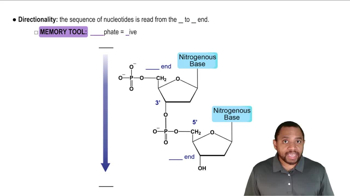
    Molecular component of nucleotides, responsible for connecting sugars and marking the 5' end of nucleic acids.
  • Pentose Sugar

    Five-carbon ring structure in nucleotides, serving as the attachment point for both phosphate and nitrogenous base.
  • Nitrogenous Base

    Variable molecular group attached to the sugar in nucleotides, providing the sequence diversity in nucleic acids.
  • Backbone

    Repeating sequence of phosphate and sugar units in nucleic acids, providing structural support for the chain.
  • Directionality

    Orientation of a nucleic acid strand, defined by the sequence being read from the 5' end to the 3' end.
  • 5' End

    Terminus of a nucleic acid strand characterized by a free phosphate group, marking the starting point for reading.
  • 3' End

    Terminus of a nucleic acid strand characterized by a free hydroxyl group, marking the endpoint for reading.
  • Sequence

    Order of nitrogenous bases along a nucleic acid chain, determining the genetic code and potential protein products.
  • Hydroxyl Group

    Functional group (-OH) present at the 3' end of a nucleic acid, distinguishing it from the 5' end.