Back

Primary Structure of Nucleic Acids quiz

Control buttons has been changed to "navigation" mode.
1/15
  • What is the primary structure of a nucleic acid?

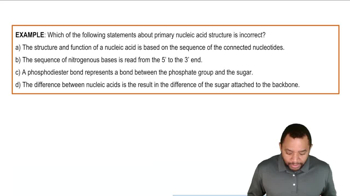
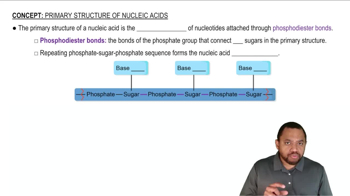
    It is the sequence of nucleotides connected by phosphodiester bonds.
  • What three components make up a nucleotide?

    A phosphate group, a pentose sugar, and a nitrogenous base.
  • What type of bond connects two nucleotides in a nucleic acid?

    A phosphodiester bond connects two nucleotides.
  • What forms the backbone of a nucleic acid?

    The repeating phosphate-sugar sequence forms the nucleic acid backbone.
  • Where are nitrogenous bases attached in the nucleic acid structure?

    They are attached to the pentose sugar in each nucleotide.
  • How is directionality in nucleic acids defined?

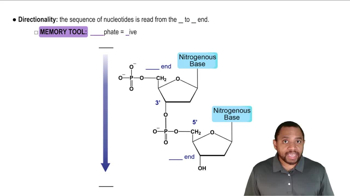
    It is defined by reading the sequence from the 5' end to the 3' end.
  • What marks the 5' end of a nucleic acid strand?

    A free phosphate group marks the 5' end.
  • What marks the 3' end of a nucleic acid strand?

    A free hydroxyl (OH) group marks the 3' end.
  • What is the significance of the sequence of nitrogenous bases in nucleic acids?

    The sequence determines the primary structure and can lead to different proteins being synthesized.
  • What is a helpful memory tool for remembering the 5' end of a nucleic acid?

    Phosphate sounds like 'f', which stands for 5, so phosphate equals 5' end.
  • What happens when more nucleotides are added to a nucleic acid chain?

    The chain elongates, forming a longer primary structure with more phosphodiester bonds.
  • Can the nitrogenous bases in a nucleic acid chain be the same or different?

    They can be the same or different, leading to variation in primary structure.
  • What connects the phosphate group of one nucleotide to the sugar of another?

    A phosphodiester bond connects the phosphate group of one nucleotide to the sugar of another.
  • Why is the order of nitrogenous bases important in nucleic acids?

    Because it determines the genetic information and the type of protein that can be produced.
  • How do you read the sequence of a nucleic acid chain?

    You read it from the 5' end (phosphate) to the 3' end (hydroxyl group).