Back

Significant Figures: In Calculations quiz

Control buttons has been changed to "navigation" mode.
1/15
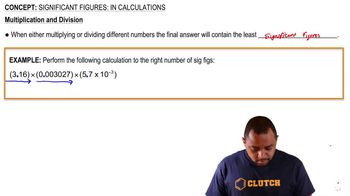
  • What rule do you follow for significant figures when multiplying or dividing numbers?

    The final answer should have the least number of significant figures among the numbers used in the calculation.
  • How do you determine the number of significant figures in a number written in scientific notation?

    Count the significant figures in the coefficient only, ignoring the exponent.
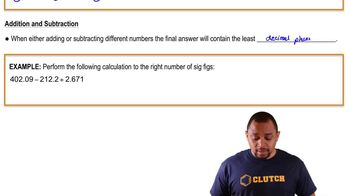
  • When adding or subtracting numbers, what determines the number of decimal places in the final answer?

    The final answer should have the least number of decimal places from the numbers used in the operation.
  • If you multiply 3.16, 0.003027, and 5.7 × 10⁻³, how many significant figures should your answer have?

    The answer should have 2 significant figures, matching the value with the least sig figs (5.7 × 10⁻³).
  • What is the first step in determining significant figures for a number with a decimal point?

    Start counting from the first non-zero digit on the left and count all digits to the end.
  • How do you round your answer if the digit to the right of your last significant figure is 5 or greater?

    You round up the last significant figure by one.
  • In the calculation 402.09 - 12.2 + 2.671, how many decimal places should the final answer have?

    The answer should have 1 decimal place, matching the number with the least decimal places (12.2).
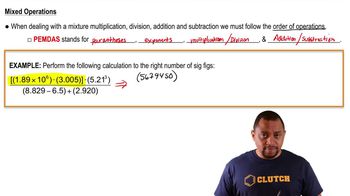
  • What is the order of operations you should follow in mixed calculations involving significant figures?

    Follow PEMDAS: Parentheses, Exponents, Multiplication/Division, Addition/Subtraction.
  • When performing mixed operations, when should you apply the rules for significant figures and decimal places?

    Apply the rules at each step according to the type of operation being performed.
  • If you divide two numbers and one has 3 sig figs and the other has 2 sig figs, how many sig figs should your answer have?

    The answer should have 2 significant figures, matching the number with the least sig figs.
  • Why is it important not to put all numbers into the calculator at once during mixed operations?

    Doing calculations step by step allows you to apply the correct significant figure or decimal place rules at each stage.
  • How do you handle significant figures when converting your final answer to scientific notation?

    Ensure the result has the correct number of significant figures as dictated by the least precise number in the calculation.
  • What happens to the number of significant figures in your answer if you add numbers with different decimal places?

    The answer is limited by the number with the least decimal places, which may affect the total significant figures.
  • In a calculation, if the intermediate result has more significant figures than allowed, what should you do?

    Round the intermediate result to the correct number of significant figures before proceeding to the next step.
  • What is the key difference between handling significant figures in multiplication/division versus addition/subtraction?

    Multiplication/division uses the least number of significant figures, while addition/subtraction uses the least number of decimal places.