Back

Solubility and Intermolecular Forces definitions

Control buttons has been changed to "navigation" mode.
1/13
  • Polarity

    Property describing the distribution of electrical charge, influencing how substances interact and dissolve with each other.
  • Intermolecular Force

    Attractive interaction between molecules, determining how substances mix and dissolve.
  • Hydrogen Bonding

    Strong polar interaction occurring when hydrogen is bonded to highly electronegative atoms like oxygen or nitrogen.
  • Dipole-Dipole

    Attraction between molecules with permanent partial positive and negative charges due to unequal electron sharing.
  • London Dispersion

    Weak, temporary attraction between non-polar molecules caused by momentary shifts in electron density.
  • Solution

    Uniform mixture where components dissolve completely, resulting in a single phase.
  • Homogeneous Mixture

    Combination of substances with uniform composition and properties throughout the sample.
  • Heterogeneous Mixture

    Combination of substances with non-uniform composition, where different parts remain distinct.
  • Solvent

    Component in a mixture present in the greatest amount, responsible for dissolving other substances.
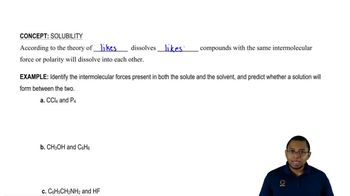
  • Like Dissolves Like

    Principle stating that substances with similar polarity or intermolecular forces mix well together.
  • Non-Polar Compound

    Substance lacking significant charge separation, resulting in weak intermolecular attractions.
  • Polar Compound

    Substance with uneven charge distribution, leading to strong interactions with other polar substances.
  • Mixing

    Process where substances combine, potentially forming a uniform or non-uniform composition depending on their properties.