Back

Transcription: mRNA Synthesis quiz

Control buttons has been changed to "navigation" mode.
1/15
  • What is a gene in the context of transcription?

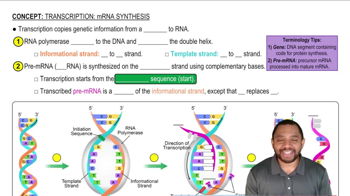
    A gene is a DNA segment containing the code for protein synthesis. Only specific gene segments are transcribed to make pre-mRNA.
  • What is pre-mRNA and how is it related to mRNA?

    Pre-mRNA is the precursor to mRNA and is processed later to become mature mRNA. It is also called hnRNA.
  • What enzyme is responsible for synthesizing pre-mRNA during transcription?

    RNA polymerase is the enzyme that synthesizes pre-mRNA. It binds to DNA, unwinds it, and facilitates RNA synthesis.
  • What does it mean that the DNA double helix is anti-parallel?

    It means one DNA strand runs 5' to 3' and the other runs 3' to 5'. The two strands are oriented in opposite directions.
  • Which DNA strand is used as a template for pre-mRNA synthesis?

    The template strand, which runs 3' to 5', is used for pre-mRNA synthesis. RNA polymerase reads this strand to build the RNA molecule.
  • How does pre-mRNA relate to the informational strand of DNA?

    Pre-mRNA is a copy of the informational strand except that uracil (U) replaces thymine (T). Both run 5' to 3' and have similar sequences.
  • What is the role of the initiation sequence in transcription?

    The initiation sequence signals where RNA polymerase should start transcription. It marks the beginning of the gene to be transcribed.
  • What happens at the termination sequence during transcription?

    The termination sequence signals RNA polymerase to stop transcription. At this point, pre-mRNA is released and DNA rewinds.
  • What is the main difference in base composition between DNA and RNA?

    DNA contains thymine (T), while RNA contains uracil (U) instead. All other bases (A, C, G) are the same.
  • How are complementary bases used during pre-mRNA synthesis?

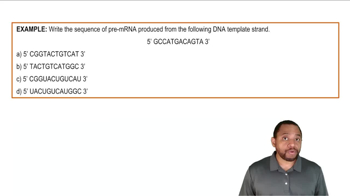
    RNA polymerase adds RNA nucleotides that are complementary to the DNA template strand. For example, A pairs with U and C pairs with G in RNA.
  • What direction is pre-mRNA synthesized in relation to the template strand?

    Pre-mRNA is synthesized anti-parallel to the template strand, running 5' to 3'. The template strand runs 3' to 5'.
  • What happens to DNA after pre-mRNA is synthesized?

    After pre-mRNA synthesis, DNA rewinds back into its double helix structure. The hydrogen bonds between bases reform.
  • What are free RNA nucleotides and what is their role in transcription?

    Free RNA nucleotides are floating in the nucleus and are used by RNA polymerase to build the pre-mRNA strand. They pair with complementary bases on the template strand.
  • Why are pre-mRNA and the informational DNA strand considered copies of each other?

    They have the same sequence except that pre-mRNA has uracil instead of thymine. Both run 5' to 3' and encode the same genetic information.
  • What is the significance of complementary base pairing in transcription?

    Complementary base pairing ensures that the RNA sequence accurately reflects the DNA template. This fidelity is crucial for correct protein synthesis.