Pearson+ LogoPearson+ Logo
Ch.10 Proteins Workers of the Cell
Frost - General, Organic and Biological Chemistry 4th Edition
Frost4th EditionGeneral, Organic and Biological ChemistryISBN: 9780134988696Not the one you use?Change textbook
Chapter 6, Problem 5

Classify each amino acid in Problem 10.4 as polar (neutral, acidic, or basic) or nonpolar and as hydrophobic or hydrophilic.
a. leucine
b. glutamate
c. methionine
d. threonine

Verified step by step guidance
1
Identify the amino acids listed in Problem 10.4 and examine their side chains (R groups). The classification of amino acids depends on the chemical properties of their side chains.
Determine if the side chain contains polar functional groups such as hydroxyl (-OH), amine (-NH2), or carboxyl (-COOH). If it does, classify the amino acid as polar. If the side chain is primarily composed of hydrocarbons or lacks polar groups, classify it as nonpolar.
For polar amino acids, further classify them as neutral, acidic, or basic. Neutral polar amino acids have side chains with polar groups but no charge at physiological pH. Acidic amino acids have side chains with a negative charge (e.g., carboxyl groups that lose a proton). Basic amino acids have side chains with a positive charge (e.g., amine groups that gain a proton).
Assess whether the amino acid is hydrophobic or hydrophilic. Nonpolar amino acids are typically hydrophobic because they do not interact well with water, while polar amino acids are hydrophilic due to their ability to form hydrogen bonds with water.
Summarize the classification for each amino acid in Problem 10.4 based on the analysis of their side chains, considering both polarity and hydrophobic/hydrophilic properties.

Verified video answer for a similar problem:

This video solution was recommended by our tutors as helpful for the problem above.
Video duration:
3m
Was this helpful?

Key Concepts

Here are the essential concepts you must grasp in order to answer the question correctly.

Amino Acid Classification

Amino acids can be classified based on the properties of their side chains (R groups). They are categorized as polar (which can be neutral, acidic, or basic) or nonpolar. This classification is essential for understanding their behavior in biological systems, particularly in protein structure and function.
Recommended video:
Guided course
1:33
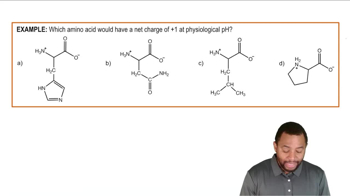
Amino Acid Classifications Example 3

Hydrophobic vs. Hydrophilic

Hydrophobic amino acids are those that do not interact favorably with water, often found in the interior of proteins, while hydrophilic amino acids interact well with water and are typically located on the protein's surface. This distinction is crucial for predicting how proteins fold and function in aqueous environments.
Recommended video:
Guided course
3:33
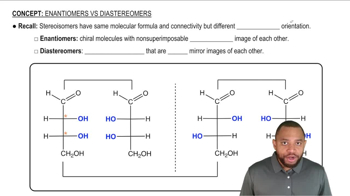
Enantiomers vs Diastereomers Concept 1

Polarity of Amino Acids

The polarity of an amino acid is determined by the electronegativity of the atoms in its side chain. Polar amino acids have side chains that can form hydrogen bonds, making them more soluble in water, while nonpolar amino acids have hydrophobic side chains that repel water. Understanding polarity helps in predicting interactions within proteins and between proteins and their environments.
Recommended video:
Guided course
2:55
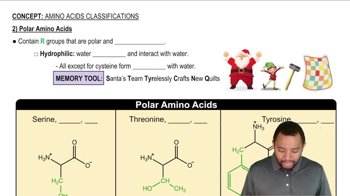
Polar Amino Acids Concept 2