Pearson+ LogoPearson+ Logo
Ch.11 Nucleic Acids Big Molecules with a Big Role
Frost - General, Organic and Biological Chemistry 4th Edition
Frost4th EditionGeneral, Organic and Biological ChemistryISBN: 9780134988696Not the one you use?Change textbook
Chapter 7, Problem 88

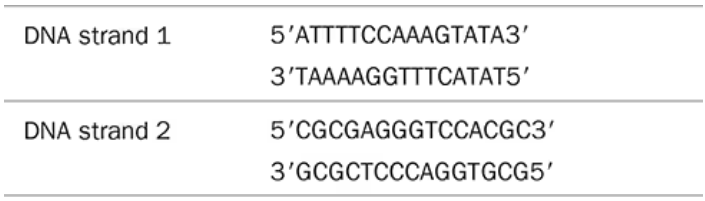
The DNA double helix can unwind, or denature, at temperatures between 90 °C and 99 °C. Denaturing occurs when H bonds are broken. Which of the following strands of DNA would be expected to denature at a higher temperature? Provide an explanation.

Verified step by step guidance
1
Identify the key concept: DNA denaturation occurs when hydrogen bonds between complementary base pairs are broken. The stability of the DNA strand depends on the number of hydrogen bonds present.
Recall the base pairing rules: Adenine (A) pairs with Thymine (T) via 2 hydrogen bonds, while Cytosine (C) pairs with Guanine (G) via 3 hydrogen bonds. Strands with more C-G pairs will have higher stability and require higher temperatures to denature.
Examine the DNA strands provided in the image (not shown here). Count the number of A-T pairs and C-G pairs in each strand to determine the relative number of hydrogen bonds.
Compare the total number of hydrogen bonds in each strand. The strand with more C-G pairs will have a higher melting temperature because it has more hydrogen bonds to break during denaturation.
Conclude that the DNA strand with the higher proportion of C-G pairs will denature at a higher temperature, and explain this based on the stronger hydrogen bonding in C-G pairs compared to A-T pairs.

Verified video answer for a similar problem:

This video solution was recommended by our tutors as helpful for the problem above.
Video duration:
5m
Was this helpful?

Key Concepts

Here are the essential concepts you must grasp in order to answer the question correctly.

DNA Structure

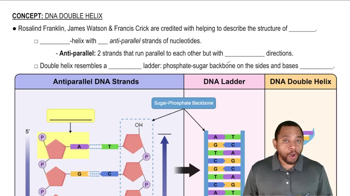
DNA is composed of two strands forming a double helix, held together by hydrogen bonds between complementary base pairs (adenine-thymine and guanine-cytosine). The stability of this structure is influenced by the number of hydrogen bonds and the overall sequence of the DNA, which can affect the temperature at which the strands denature.
Recommended video:
Guided course
3:27
DNA Double Helix Concept 1

Denaturation

Denaturation refers to the process where the double-stranded DNA unwinds and separates into single strands due to the breaking of hydrogen bonds, typically induced by high temperatures. The temperature at which this occurs is known as the melting temperature (Tm), which varies based on the DNA's composition and length.
Recommended video:
Guided course
1:17
Digestion of Proteins Example 1

GC Content

GC content refers to the proportion of guanine and cytosine bases in a DNA molecule. Since guanine and cytosine form three hydrogen bonds compared to the two formed by adenine and thymine, DNA with a higher GC content is generally more stable and requires a higher temperature to denature compared to DNA with a lower GC content.