
Pearson+ LogoPearson+ Logo
Ch.11 Nucleic Acids Big Molecules with a Big Role
Frost - General, Organic and Biological Chemistry 4th Edition
Frost4th EditionGeneral, Organic and Biological ChemistryISBN: 9780134988696Not the one you use?Change textbook
Chapter 7, Problem 85a

Alpha-melanocyte stimulating hormone (α-MSH) is a 13-amino-acid peptide hormone responsible for pigmentations in hair and skin. Its peptide sequence is shown.
SYSMQHFRWGKPV
a. How many nucleotides would be found in the mRNA for this protein?

Verified step by step guidance
1
Step 1: Understand the relationship between amino acids and nucleotides. Each amino acid in a protein is encoded by a codon in mRNA, and each codon consists of three nucleotides.
Step 2: Count the number of amino acids in the given peptide sequence. The sequence provided is SYSMQHFRWGKPV, which contains 13 amino acids.
Step 3: Multiply the number of amino acids by the number of nucleotides per codon. Since each amino acid corresponds to one codon and each codon consists of three nucleotides, the total number of nucleotides is calculated as: 13×3.
Step 4: Consider any additional nucleotides that might be present in the mRNA, such as start and stop codons. The start codon (AUG) and a stop codon (e.g., UAA, UAG, or UGA) are typically included in the mRNA sequence.
Step 5: Add the nucleotides for the start and stop codons to the total calculated in Step 3. This ensures the complete mRNA sequence is accounted for.

Verified video answer for a similar problem:

This video solution was recommended by our tutors as helpful for the problem above.
Video duration:
1m
Was this helpful?

Key Concepts

Here are the essential concepts you must grasp in order to answer the question correctly.

Peptide Hormones

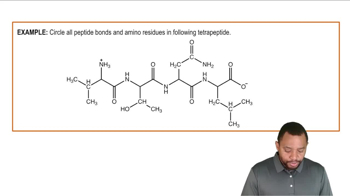
Peptide hormones are short chains of amino acids that act as signaling molecules in the body. They are synthesized in the ribosomes and play crucial roles in various physiological processes, including growth, metabolism, and pigmentation. Understanding the structure and function of peptide hormones, like α-MSH, is essential for grasping how they influence biological functions.
Recommended video:
Guided course
1:24
Peptides Example 1

Genetic Code

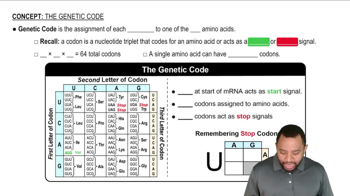
The genetic code is the set of rules by which information encoded in genetic material is translated into proteins. Each amino acid in a protein is specified by a sequence of three nucleotides, known as a codon, in the mRNA. Knowing how the genetic code translates nucleotide sequences into amino acids is vital for determining the mRNA length corresponding to a given peptide.
Recommended video:
Guided course
03:25
The Genetic Code Concept 1

mRNA Synthesis

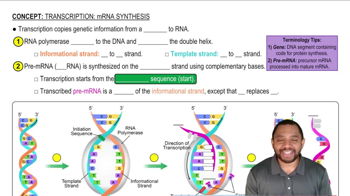
mRNA synthesis, or transcription, is the process by which a segment of DNA is copied into mRNA. This process involves the enzyme RNA polymerase and results in a single-stranded RNA molecule that carries the genetic information from the DNA to the ribosome for protein synthesis. Understanding mRNA synthesis is crucial for calculating the number of nucleotides needed to encode a specific peptide sequence.
Recommended video:
Guided course
6:37
Transcription: mRNA Synthesis Concept 1