Pearson+ LogoPearson+ Logo
Ch.12 Food as Fuel An Overview of Metabolism
Frost - General, Organic and Biological Chemistry 4th Edition
Frost4th EditionGeneral, Organic and Biological ChemistryISBN: 9780134988696Not the one you use?Change textbook
Chapter 8, Problem 19

Name the end products for digestion of proteins.

Verified step by step guidance
1
Understand that proteins are large biomolecules composed of amino acids linked together by peptide bonds. During digestion, these bonds are broken down into smaller units.
Recognize that the digestion of proteins begins in the stomach, where the enzyme pepsin and hydrochloric acid work together to break proteins into smaller polypeptides.
Learn that in the small intestine, enzymes such as trypsin and chymotrypsin (produced by the pancreas) further break down polypeptides into smaller peptides.
Understand that peptidases (also produced by the pancreas and small intestine) break down these smaller peptides into individual amino acids, which are the final products of protein digestion.
Conclude that the end products of protein digestion are amino acids, which are absorbed into the bloodstream through the walls of the small intestine for use by the body.

Verified video answer for a similar problem:

This video solution was recommended by our tutors as helpful for the problem above.
Video duration:
3m
Was this helpful?

Key Concepts

Here are the essential concepts you must grasp in order to answer the question correctly.

Proteins

Proteins are large, complex molecules made up of amino acids, which are essential for various bodily functions. They play a critical role in building and repairing tissues, making enzymes and hormones, and supporting immune function. Understanding the structure and function of proteins is crucial for comprehending how they are digested and utilized by the body.
Recommended video:
Guided course
2:01
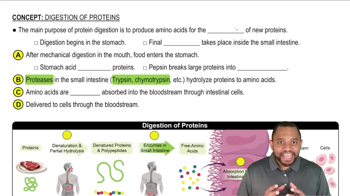
Digestion of Proteins Concept 1

Digestion Process

The digestion of proteins begins in the stomach, where enzymes like pepsin break down protein molecules into smaller peptides. This process continues in the small intestine, where pancreatic enzymes further digest peptides into individual amino acids. Recognizing the stages of protein digestion helps in understanding how the body absorbs and utilizes these nutrients.
Recommended video:
Guided course
2:01
Digestion of Proteins Concept 1

End Products of Digestion

The end products of protein digestion are primarily amino acids, which are the building blocks of proteins. These amino acids can be absorbed into the bloodstream and transported to cells throughout the body, where they are used to synthesize new proteins or converted into energy. Identifying these end products is essential for understanding nutritional needs and metabolic processes.
Recommended video:
Guided course
1:41
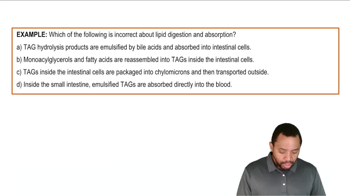
Digestion of Lipids Example 1