Pearson+ LogoPearson+ Logo
Ch.4 Introduction to Organic Compounds
Frost - General, Organic and Biological Chemistry 4th Edition
Frost4th EditionGeneral, Organic and Biological ChemistryISBN: 9780134988696Not the one you use?Change textbook
Chapter 1, Problem 45

Alkanes are also referred to as saturated hydrocarbons. Explain the meaning of the term hydrocarbon. Why are alkanes called saturated hydrocarbons?

Verified step by step guidance
1
The term 'hydrocarbon' refers to organic compounds that are composed entirely of carbon (C) and hydrogen (H) atoms. These compounds form the basis of organic chemistry and can exist in various structures such as chains, rings, or branched forms.
Alkanes are a specific type of hydrocarbon that contain only single bonds between carbon atoms. This means that each carbon atom is bonded to the maximum possible number of hydrogen atoms, making them 'saturated.'
The term 'saturated' in this context means that the carbon atoms are fully bonded with hydrogen atoms and there are no double or triple bonds present in the molecule.
The general formula for alkanes is CnH2n+2, where 'n' represents the number of carbon atoms. This formula reflects the maximum number of hydrogen atoms that can bond to a given number of carbon atoms in a single-bonded structure.
In summary, alkanes are called saturated hydrocarbons because they consist only of carbon and hydrogen atoms, and their carbon atoms are fully saturated with hydrogen due to the presence of only single bonds.

Verified video answer for a similar problem:

This video solution was recommended by our tutors as helpful for the problem above.
Video duration:
3m
Was this helpful?

Key Concepts

Here are the essential concepts you must grasp in order to answer the question correctly.

Hydrocarbon

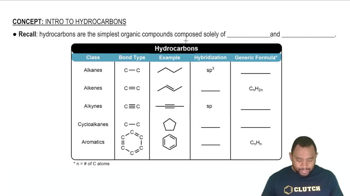
A hydrocarbon is a chemical compound composed exclusively of hydrogen and carbon atoms. These compounds can be found in various forms, including alkanes, alkenes, and alkynes, which differ based on the types of bonds between carbon atoms. Hydrocarbons are fundamental to organic chemistry and are the primary constituents of fossil fuels, making them crucial for energy production.
Recommended video:
Guided course
4:29
Intro to Hydrocarbons Concept 1

Saturated Hydrocarbons

Saturated hydrocarbons, also known as alkanes, are hydrocarbons in which all carbon-carbon bonds are single bonds. This saturation means that each carbon atom is bonded to the maximum number of hydrogen atoms possible, resulting in a stable structure. The general formula for saturated hydrocarbons is CnH2n+2, where 'n' represents the number of carbon atoms.
Recommended video:
Guided course
0:57
Saturated and Unsaturated Hydrocarbons Example 2

Alkanes

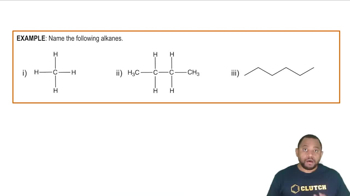
Alkanes are a specific class of saturated hydrocarbons characterized by their single bonds between carbon atoms. They are the simplest type of hydrocarbons and include compounds such as methane, ethane, and propane. Alkanes are typically less reactive than other types of hydrocarbons, making them useful as fuels and in various chemical applications.
Recommended video:
Guided course
1:20
Naming Alkanes Example 1