Pearson+ LogoPearson+ Logo
Ch.4 Introduction to Organic Compounds
Frost - General, Organic and Biological Chemistry 4th Edition
Frost4th EditionGeneral, Organic and Biological ChemistryISBN: 9780134988696Not the one you use?Change textbook
Chapter 1, Problem 33b

Determine if each of the following cycloalkanes or alkenes can exist as cis–trans stereoisomers. For those that can, draw the two isomers. Label each of the isomers you drew as the cis stereoisomer or the trans stereoisomer.
(b) CH3CH2CH2CH2CH=CH2

Verified step by step guidance
1
Step 1: Understand the concept of cis-trans stereoisomerism. Cis-trans stereoisomerism occurs in alkenes when there is restricted rotation around the double bond and each carbon atom of the double bond has two different groups attached to it. This allows for two distinct arrangements: cis (same side) and trans (opposite sides).
Step 2: Analyze the given compound, CH₃CH₂CH₂CH₂CH=CH₂. Identify the double bond in the structure, which is between the last two carbon atoms (C5=C6).
Step 3: Examine the groups attached to each carbon atom of the double bond. For cis-trans isomerism to occur, each carbon atom in the double bond must have two different groups attached. In this case, C5 is attached to CH₂CH₂CH₂CH₃ (a butyl group) and a hydrogen atom, while C6 is attached to a hydrogen atom and another hydrogen atom.
Step 4: Determine if cis-trans isomerism is possible. Since C6 has two identical groups (both are hydrogen atoms), the compound does not meet the requirement for cis-trans isomerism. Therefore, this compound cannot exist as cis-trans stereoisomers.
Step 5: Conclude that no cis-trans isomers can be drawn for CH₃CH₂CH₂CH₂CH=CH₂ because the necessary condition of having two different groups on each carbon of the double bond is not satisfied.

Verified video answer for a similar problem:

This video solution was recommended by our tutors as helpful for the problem above.
Video duration:
4m
Was this helpful?

Key Concepts

Here are the essential concepts you must grasp in order to answer the question correctly.

Cis-Trans Isomerism

Cis-trans isomerism, also known as geometric isomerism, occurs in compounds with restricted rotation around a double bond or within a ring structure. In alkenes, the 'cis' isomer has substituents on the same side of the double bond, while the 'trans' isomer has them on opposite sides. This spatial arrangement can significantly affect the physical and chemical properties of the compounds.
Recommended video:
Guided course
2:47
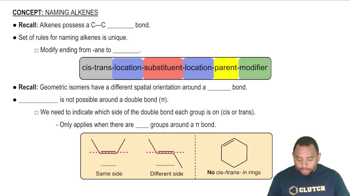
Rules for Naming Alkenes Concept 1

Cycloalkanes and Alkenes

Cycloalkanes are saturated hydrocarbons with carbon atoms arranged in a ring, while alkenes are unsaturated hydrocarbons containing at least one carbon-carbon double bond. The presence of a double bond in alkenes allows for the possibility of cis-trans isomerism, depending on the substituents attached to the carbon atoms involved in the double bond. Understanding the structure of these compounds is essential for identifying isomerism.
Recommended video:
Guided course
3:26
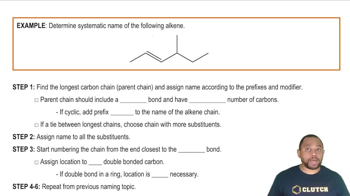
Naming Alkenes Example 1

Drawing Isomers

Drawing isomers involves representing the different spatial arrangements of atoms in a molecule. For cis-trans isomers, it is important to accurately depict the orientation of substituents around the double bond. Labeling each isomer as 'cis' or 'trans' helps clarify their differences and is crucial for understanding their chemical behavior and reactivity.
Recommended video:
Guided course
2:28
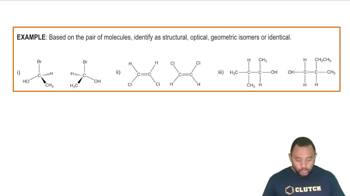
Isomers Example 1