Pearson+ LogoPearson+ Logo
Ch.4 Introduction to Organic Compounds
Frost - General, Organic and Biological Chemistry 4th Edition
Frost4th EditionGeneral, Organic and Biological ChemistryISBN: 9780134988696Not the one you use?Change textbook
Chapter 1, Problem 31b

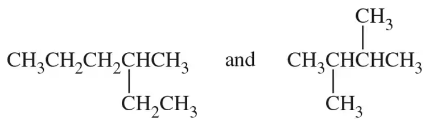
Determine the relationship between each of the pairs of the following compounds. Are they structural isomers (different molecules), conformational isomers (the same molecule), or not related?
(b)

Verified step by step guidance
1
Examine the molecular formulas of both compounds to determine if they have the same number and type of atoms. If the molecular formulas differ, the compounds are not related.
If the molecular formulas are the same, analyze the connectivity of the atoms in each compound. Check if the atoms are bonded in the same sequence. If the connectivity differs, the compounds are structural isomers.
If the connectivity is the same, examine the spatial arrangement of the atoms. Rotate or flip the molecules to see if they can be superimposed. If they can be superimposed, they are conformational isomers (the same molecule).
If the molecules cannot be superimposed but have the same connectivity, they may be stereoisomers (e.g., enantiomers or diastereomers). However, this is not explicitly mentioned in the problem, so focus on structural and conformational isomers.
Summarize the relationship based on your analysis: structural isomers, conformational isomers, or not related. Ensure you clearly justify your conclusion based on the steps above.

Verified video answer for a similar problem:

This video solution was recommended by our tutors as helpful for the problem above.
Video duration:
3m
Was this helpful?

Key Concepts

Here are the essential concepts you must grasp in order to answer the question correctly.

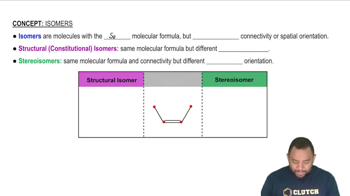
Structural Isomers

Structural isomers are compounds that have the same molecular formula but differ in the arrangement of atoms within the molecule. This can include variations in the connectivity of atoms, leading to different functional groups or chain structures. For example, butane and isobutane are structural isomers, as they have the same formula (C4H10) but different structures.
Recommended video:
Guided course
2:16
Isomers Concept 1

Conformational Isomers

Conformational isomers, also known as rotamers, are different spatial arrangements of the same molecule that can be interconverted by rotation around single bonds. These isomers do not involve breaking any bonds and typically exist in equilibrium. An example is the staggered and eclipsed conformations of ethane, which differ in their spatial orientation but are the same compound.
Recommended video:
Guided course
2:16
Isomers Concept 1

Relationship Analysis

Analyzing the relationship between compounds involves determining whether they are structural isomers, conformational isomers, or unrelated. This requires examining their molecular formulas, structures, and connectivity. Understanding these relationships is crucial in organic chemistry for predicting reactivity, stability, and properties of compounds.
Recommended video:
Guided course
06:11
Dimensional Analysis