Pearson+ LogoPearson+ Logo
Ch.5 Chemical Reactions
Frost - General, Organic and Biological Chemistry 4th Edition
Frost4th EditionGeneral, Organic and Biological ChemistryISBN: 9780134988696Not the one you use?Change textbook
Chapter 2, Problem 30c

Are the substances shown in italics undergoing oxidation or reduction?
(c) The biomolecule FADH2 loses hydrogen, becoming FAD.

Verified step by step guidance
1
Identify the key chemical change occurring in the problem: The biomolecule FADH₂ is losing hydrogen atoms to become FAD.
Recall the definition of oxidation: Oxidation is the loss of electrons, which often corresponds to the loss of hydrogen atoms in organic and biochemical reactions.
Analyze the change: Since FADH₂ is losing hydrogen atoms, it is undergoing oxidation.
Understand the broader context: In biochemical reactions, molecules like FADH₂ act as electron carriers. When they lose hydrogen atoms, they are oxidized, and this process is often coupled with the reduction of another molecule.
Conclude that the substance undergoing the change (FADH₂) is being oxidized, as it loses hydrogen atoms and electrons in the process.

Verified video answer for a similar problem:

This video solution was recommended by our tutors as helpful for the problem above.
Video duration:
1m
Was this helpful?

Key Concepts

Here are the essential concepts you must grasp in order to answer the question correctly.

Oxidation and Reduction

Oxidation and reduction are chemical processes that involve the transfer of electrons between substances. Oxidation refers to the loss of electrons or an increase in oxidation state, while reduction involves the gain of electrons or a decrease in oxidation state. These processes are often coupled, meaning that when one substance is oxidized, another is reduced.
Recommended video:
Guided course
0:55
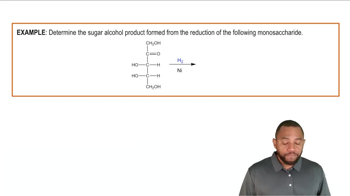
Reduction of Monosaccharides Example 1

Hydrogen Loss in Redox Reactions

In many biochemical reactions, the loss of hydrogen atoms is indicative of oxidation. When a molecule like FADH₂ loses hydrogen, it is effectively losing electrons, which signifies that it is being oxidized to form FAD. This transformation is a common example of how redox reactions occur in biological systems.
Recommended video:
Guided course
1:22
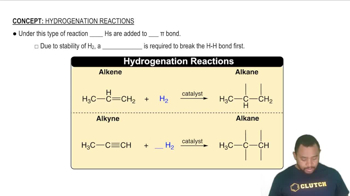
Hydrogenation Reactions Concept 1

Biomolecules in Metabolism

Biomolecules such as FADH₂ play crucial roles in metabolic pathways, particularly in cellular respiration. FADH₂ acts as an electron carrier, transferring electrons to the electron transport chain, which ultimately leads to ATP production. Understanding the role of these biomolecules in redox reactions is essential for grasping metabolic processes.
Recommended video:
Guided course
0:52
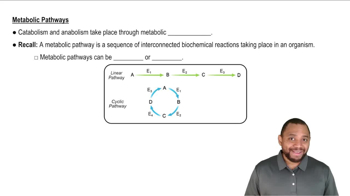
Metabolic Pathways Concept 2