Pearson+ LogoPearson+ Logo
Ch.5 Chemical Reactions
Frost - General, Organic and Biological Chemistry 4th Edition
Frost4th EditionGeneral, Organic and Biological ChemistryISBN: 9780134988696Not the one you use?Change textbook
Chapter 2, Problem 29c

Are the substances shown in italics undergoing oxidation or reduction?
(c) Wine (containing ethanol, CH3CH2OH) sours to vinegar (CH3COOH).

Verified step by step guidance
1
Identify the chemical change occurring in the reaction. Ethanol (CH₃CH₂OH) is being converted to acetic acid (CH₃COOH).
Determine the oxidation states of the carbon atoms in ethanol (CH₃CH₂OH). The carbon in the -CH₃ group has an oxidation state of -3, and the carbon in the -CH₂OH group has an oxidation state of -1.
Determine the oxidation states of the carbon atoms in acetic acid (CH₃COOH). The carbon in the -CH₃ group remains at -3, but the carbon in the -COOH group has an oxidation state of +3.
Compare the oxidation states of the carbon atom in the -CH₂OH group (from ethanol) and the -COOH group (in acetic acid). The oxidation state increases from -1 to +3, indicating a loss of electrons.
Conclude that the substance undergoing the change (ethanol) is being oxidized, as oxidation is defined as the loss of electrons or an increase in oxidation state.

Verified video answer for a similar problem:

This video solution was recommended by our tutors as helpful for the problem above.
Video duration:
1m
Was this helpful?

Key Concepts

Here are the essential concepts you must grasp in order to answer the question correctly.

Oxidation and Reduction

Oxidation and reduction are chemical processes that involve the transfer of electrons between substances. Oxidation refers to the loss of electrons, while reduction involves the gain of electrons. These processes are often coupled, meaning that when one substance is oxidized, another is reduced. Understanding these concepts is crucial for analyzing chemical reactions, such as the conversion of ethanol to acetic acid.
Recommended video:
Guided course
0:55
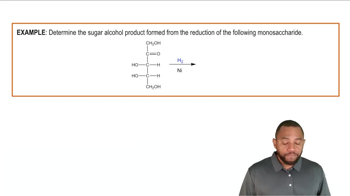
Reduction of Monosaccharides Example 1

Ethanol to Acetic Acid Conversion

The conversion of ethanol (CH₃CH₂OH) to acetic acid (CH₃COOH) is a classic example of an oxidation reaction. In this process, ethanol is oxidized, losing electrons and forming acetic acid. This transformation is commonly observed in the fermentation process, where ethanol is produced and subsequently oxidized to acetic acid, leading to the souring of wine into vinegar.
Recommended video:
Guided course
2:17
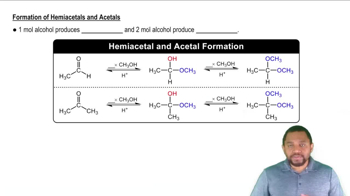
Formation of Hemiacetals and Acetals Concept 2

Role of Oxygen in Oxidation

Oxygen plays a significant role in many oxidation reactions, acting as an electron acceptor. In the case of ethanol oxidation, oxygen from the environment or from other reactants can facilitate the transfer of electrons, promoting the conversion of ethanol to acetic acid. This highlights the importance of oxygen in biological and chemical processes, particularly in fermentation and spoilage reactions.