Pearson+ LogoPearson+ Logo
Ch.5 Chemical Reactions
Frost - General, Organic and Biological Chemistry 4th Edition
Frost4th EditionGeneral, Organic and Biological ChemistryISBN: 9780134988696Not the one you use?Change textbook
Chapter 2, Problem 39a

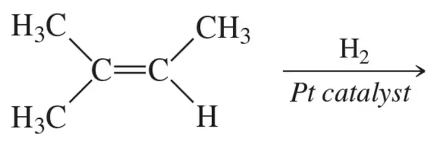
Write the products for the following hydrogenation reactions:
(a)

Verified step by step guidance
1
Identify the type of compound undergoing hydrogenation. Hydrogenation typically involves alkenes or alkynes reacting with hydrogen (H₂) in the presence of a catalyst, such as Pt, Pd, or Ni.
Determine the structure of the reactant from the provided image. If the reactant is an alkene, the double bond will be converted into a single bond. If it is an alkyne, the triple bond will be reduced to a double bond (partial hydrogenation) or a single bond (complete hydrogenation).
Write the balanced chemical equation for the reaction. For example, if the reactant is an alkene, add H₂ to the double bond to form the corresponding alkane.
Draw the structure of the product. Replace the double or triple bond in the reactant with single bonds, and add the appropriate number of hydrogen atoms to the carbon atoms involved in the bond.
Verify the product by ensuring that all valences of the atoms are satisfied and that the reaction follows the rules of hydrogenation.

Verified video answer for a similar problem:

This video solution was recommended by our tutors as helpful for the problem above.
Video duration:
1m
Was this helpful?

Key Concepts

Here are the essential concepts you must grasp in order to answer the question correctly.

Hydrogenation

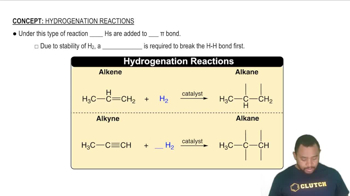
Hydrogenation is a chemical reaction that involves the addition of hydrogen (H2) to an unsaturated compound, typically an alkene or alkyne, converting it into a saturated compound. This process is commonly used in organic chemistry to reduce double or triple bonds, resulting in alkanes. The reaction often requires a catalyst, such as palladium, platinum, or nickel, to proceed efficiently.
Recommended video:
Guided course
1:22
Hydrogenation Reactions Concept 1

Reaction Products

In chemical reactions, the products are the substances formed as a result of the reaction. For hydrogenation reactions, the products are typically saturated hydrocarbons, where the unsaturated bonds have been converted to single bonds. Understanding how to predict the products of a reaction involves recognizing the structure of the reactants and applying the rules of organic chemistry.
Recommended video:
Guided course
1:08
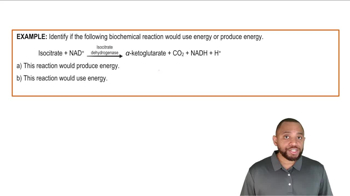
Energy Production In Biochemical Pathways Example 1

Catalysts in Hydrogenation

Catalysts are substances that increase the rate of a chemical reaction without being consumed in the process. In hydrogenation, catalysts such as nickel, palladium, or platinum facilitate the addition of hydrogen to the unsaturated bonds. The choice of catalyst can influence the reaction's selectivity and efficiency, making it a crucial aspect of industrial applications in organic synthesis.
Recommended video:
Guided course
1:22
Hydrogenation Reactions Concept 1