Pearson+ LogoPearson+ Logo
Ch.1 Matter and Measurements
McMurry - Fundamentals of GOB 8th Edition
McMurry8th EditionFundamentals of GOBISBN: 9780134015187Not the one you use?Change textbook
Chapter 1, Problem 109

An archeologist finds a 1.62 kg goblet that she believes to be made of pure gold. When 1350 cal (5650 J) of heat is added to the goblet, its temperature increases by 7.8 ℃. Calculate the specific heat of the goblet. Is it made of gold? Explain.

Verified step by step guidance
1
Step 1: Recall the formula for specific heat capacity: c = Q / (m · ΔT), where c is the specific heat capacity, Q is the heat added, m is the mass of the object, and ΔT is the change in temperature.
Step 2: Identify the given values from the problem: Q = 5650 \, J, m = 1.62 \, kg, and ΔT = 7.8 \, ^\circ C.
Step 3: Substitute the given values into the formula: c = 5650 / (1.62 · 7.8). Perform the division and multiplication in the denominator to simplify the expression.
Step 4: Compare the calculated specific heat capacity to the known specific heat capacity of gold, which is approximately 0.129 \, J/(g · ^\circ C) or 129 \, J/(kg · ^\circ C). This will help determine if the goblet is made of pure gold.
Step 5: Conclude whether the goblet is made of gold based on how closely the calculated specific heat matches the known value for gold. If the values differ significantly, the goblet is not pure gold.

Verified video answer for a similar problem:

This video solution was recommended by our tutors as helpful for the problem above.
Video duration:
3m
Was this helpful?

Key Concepts

Here are the essential concepts you must grasp in order to answer the question correctly.

Specific Heat Capacity

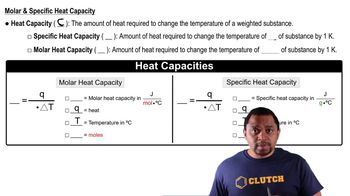
Specific heat capacity is the amount of heat required to raise the temperature of one kilogram of a substance by one degree Celsius. It is a material property that varies between different substances, allowing us to identify materials based on how they respond to heat. The formula to calculate specific heat is Q = mcΔT, where Q is the heat added, m is the mass, c is the specific heat, and ΔT is the change in temperature.
Recommended video:
Guided course
02:19
Heat Capacity

Heat Transfer

Heat transfer refers to the movement of thermal energy from one object or substance to another due to a temperature difference. In this scenario, the heat added to the goblet causes its temperature to rise, which can be quantified to determine the specific heat. Understanding heat transfer is crucial for analyzing how materials behave under thermal conditions and for making comparisons between different substances.
Recommended video:
Guided course
02:19
Heat Capacity

Material Identification

Material identification involves determining the composition of a substance based on its physical and thermal properties. In this case, by calculating the specific heat of the goblet and comparing it to known values for pure gold (approximately 0.129 J/g°C), we can assess whether the goblet is indeed made of gold. This process is essential in fields like archaeology and materials science for verifying the authenticity of artifacts.
Recommended video:
Guided course
07:46
Laboratory Materials 2