Pearson+ LogoPearson+ Logo
Ch.1 Matter and Measurements
McMurry - Fundamentals of GOB 8th Edition
McMurry8th EditionFundamentals of GOBISBN: 9780134015187Not the one you use?Change textbook
Chapter 1, Problem 108

When 1.0 tablespoon of butter is burned or used by our body, it releases 100 kcal (100 food Calories or 418.4 kJ) of energy. If we could use all the energy provided, how many tablespoons of butter would have to be burned to raise the temperature of 3.00 L of water from 18.0 ℃ to 90.0 ℃

Verified step by step guidance
1
Step 1: Calculate the amount of heat energy required to raise the temperature of 3.00 L of water from 18.0 ℃ to 90.0 ℃ using the formula for heat transfer: q = mc ⋅ ΔT, where q is the heat energy, m is the mass of water, c is the specific heat capacity of water (4.184 J/g·°C), and ΔT is the temperature change.
Step 2: Convert the volume of water (3.00 L) to mass. Since the density of water is approximately 1.00 g/mL, 3.00 L of water is equivalent to 3000 g.
Step 3: Calculate the temperature change, ΔT, by subtracting the initial temperature (18.0 ℃) from the final temperature (90.0 ℃): ΔT = 90.0 - 18.0.
Step 4: Substitute the values for m (3000 g), c (4.184 J/g·°C), and ΔT into the heat transfer formula to calculate q in joules.
Step 5: Convert the heat energy required (q) from joules to kilocalories (1 kcal = 4184 J). Then, divide the total energy required by the energy provided by 1 tablespoon of butter (100 kcal) to determine the number of tablespoons of butter needed.

Verified video answer for a similar problem:

This video solution was recommended by our tutors as helpful for the problem above.
Video duration:
5m
Was this helpful?

Key Concepts

Here are the essential concepts you must grasp in order to answer the question correctly.

Specific Heat Capacity

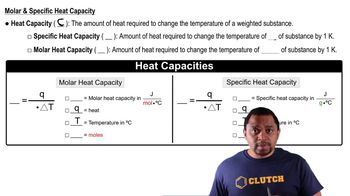
Specific heat capacity is the amount of heat required to raise the temperature of a unit mass of a substance by one degree Celsius. For water, this value is approximately 4.18 J/g°C. Understanding this concept is crucial for calculating the energy needed to heat water, as it directly relates to the mass of water and the temperature change involved.
Recommended video:
Guided course
02:19
Heat Capacity

Energy Conversion

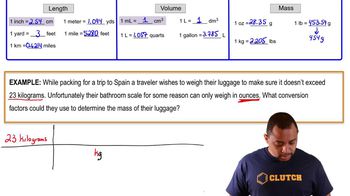
Energy conversion refers to the process of changing energy from one form to another. In this context, the energy released from burning butter (in kcal) must be converted to joules to match the units used for calculating the heat required to raise the temperature of water. This conversion is essential for accurately determining how much butter is needed.
Recommended video:
Guided course
03:45
Conversion Factors (Simplified) Example 2

Caloric Content

Caloric content indicates the amount of energy provided by food, measured in kilocalories (kcal). In this scenario, 1 tablespoon of butter provides 100 kcal of energy. Knowing the caloric content of the butter allows us to calculate how many tablespoons are necessary to supply the total energy required to heat the specified volume of water.