Pearson+ LogoPearson+ Logo
Ch.1 Matter and Measurements
McMurry - Fundamentals of GOB 8th Edition
McMurry8th EditionFundamentals of GOBISBN: 9780134015187Not the one you use?Change textbook
Chapter 1, Problem 105

A patient is receiving 3000 mL/day of a solution that contains 5 g of dextrose (glucose) per 100 mL of solution. If glucose provides 4 kcal/g of energy, how many kilocalories per day is the patient receiving from the glucose?

Verified step by step guidance
1
Step 1: Determine the total amount of glucose in grams the patient is receiving per day. Use the concentration of glucose in the solution (5 g per 100 mL) and the total volume of solution administered per day (3000 mL). The formula to calculate this is: \( \text{Total glucose (g)} = \text{Concentration (g/mL)} \times \text{Total volume (mL)} \).
Step 2: Convert the concentration of glucose from 'per 100 mL' to 'per 1 mL' for easier calculation. This can be done by dividing 5 g by 100 mL, giving \( \text{Concentration (g/mL)} = \frac{5}{100} \).
Step 3: Multiply the concentration of glucose (in g/mL) by the total volume of solution (3000 mL) to find the total mass of glucose in grams. The formula is: \( \text{Total glucose (g)} = \frac{5}{100} \times 3000 \).
Step 4: Calculate the total energy provided by the glucose. Since glucose provides 4 kcal per gram, multiply the total mass of glucose (in grams) by 4 kcal/g. The formula is: \( \text{Total energy (kcal)} = \text{Total glucose (g)} \times 4 \).
Step 5: Combine all the calculations to determine the total kilocalories per day the patient is receiving from the glucose. Ensure all units are consistent and verify the calculations step by step.

Verified video answer for a similar problem:

This video solution was recommended by our tutors as helpful for the problem above.
Video duration:
1m
Was this helpful?

Key Concepts

Here are the essential concepts you must grasp in order to answer the question correctly.

Dextrose (Glucose) Concentration

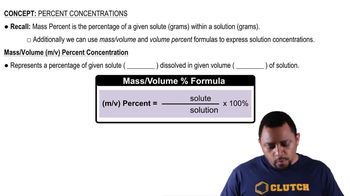
Dextrose, or glucose, is a simple sugar that serves as a primary energy source in the body. In this question, the concentration of dextrose is given as 5 g per 100 mL of solution. Understanding this concentration is crucial for calculating the total amount of glucose the patient receives daily based on their fluid intake.
Recommended video:
Guided course
00:52
Percent Concentrations Concept 1

Caloric Value of Glucose

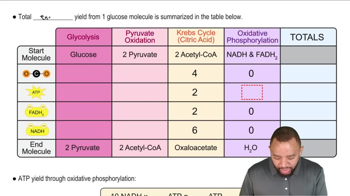
Glucose provides 4 kilocalories (kcal) of energy per gram. This caloric value is essential for converting the total grams of glucose consumed into kilocalories, which is a standard unit of energy measurement in nutrition. Knowing this conversion allows for the calculation of the total energy intake from glucose.
Recommended video:
Guided course
2:48
Total Energy From Glucose Concept 2

Total Daily Intake Calculation

To determine the total daily intake of glucose, one must first calculate the total volume of solution consumed (3000 mL) and then find out how many grams of glucose are present in that volume. This involves using the concentration of glucose in the solution and applying it to the total volume to find the total grams, which can then be converted to kilocalories using the caloric value.
Recommended video:
Guided course
2:48
Total Energy From Glucose Concept 2
Related Practice
Textbook Question

Gemstones are weighed in carats, where 1 carat = 200 mg exactly. What is the mass in grams of the Hope diamond, the world's largest blue diamond, at 44.4 carats?

1522
views
Textbook Question

The relationship between the nutritional unit for energy and the metric unit is 1 Calorie = 1 kcal.

a. One donut contains 350 Calories. Convert this to calories and joules.

1535
views
Textbook Question

Today, thermometers containing mercury are used less frequently than in the past because of concerns regarding the toxicity of mercury and because of its relatively high melting point (-39 °C). This means that mercury thermometers cannot be used in very cold environments because the mercury is a solid under such conditions. Alcohol thermometers, however, can be used over a temperature range from -115 °C (the melting point of alcohol) to 78.5 °C (the boiling point of alcohol).

b. The densities of alcohol and mercury are 0.79 g/mL and 13.6 g/mL, respectively. If the volume of liquid in a typical laboratory thermometer is 1.0 mL, what mass of alcohol is contained in the thermometer? What mass of mercury?

1834
views
Textbook Question

When 1.0 tablespoon of butter is burned or used by our body, it releases 100 kcal (100 food Calories or 418.4 kJ) of energy. If we could use all the energy provided, how many tablespoons of butter would have to be burned to raise the temperature of 3.00 L of water from 18.0 ℃ to 90.0 ℃

2006
views
Textbook Question

An archeologist finds a 1.62 kg goblet that she believes to be made of pure gold. When 1350 cal (5650 J) of heat is added to the goblet, its temperature increases by 7.8 ℃. Calculate the specific heat of the goblet. Is it made of gold? Explain.

1384
views