Pearson+ LogoPearson+ Logo
Ch.1 Matter and Measurements
McMurry - Fundamentals of GOB 8th Edition
McMurry8th EditionFundamentals of GOBISBN: 9780134015187Not the one you use?Change textbook
Chapter 1, Problem 1

Pure acetic acid, which gives the sour taste to vinegar, has a melting point of 16.7 °C and a boiling point of 118 °C . Predict the physical state of acetic acid when the ambient temperature is 10 °C .

Verified step by step guidance
1
Identify the melting point and boiling point of acetic acid: the melting point is 16.7 °C, and the boiling point is 118 °C.
Understand the physical states of a substance: below the melting point, the substance is a solid; between the melting point and boiling point, it is a liquid; above the boiling point, it is a gas.
Compare the given ambient temperature (10 °C) to the melting point (16.7 °C) and boiling point (118 °C).
Since 10 °C is below the melting point of 16.7 °C, the acetic acid will be in the solid state at this temperature.
Conclude that at 10 °C, acetic acid is a solid because the temperature is lower than its melting point.

Verified video answer for a similar problem:

This video solution was recommended by our tutors as helpful for the problem above.
Video duration:
2m
Was this helpful?

Key Concepts

Here are the essential concepts you must grasp in order to answer the question correctly.

Melting Point

The melting point is the temperature at which a solid becomes a liquid. For pure acetic acid, this point is 16.7 °C. If the ambient temperature is below this value, acetic acid will remain in its solid state.
Recommended video:
Guided course
03:05
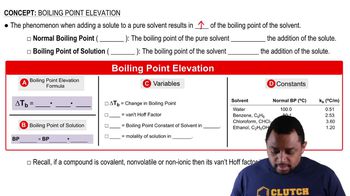
Boiling Point Elevation Concept 1

Boiling Point

The boiling point is the temperature at which a liquid turns into vapor. Acetic acid has a boiling point of 118 °C, meaning it will remain a liquid at temperatures below this threshold. This concept is crucial for understanding the phase changes of substances.
Recommended video:
Guided course
03:05
Boiling Point Elevation Concept 1

Physical State

The physical state of a substance refers to its form, which can be solid, liquid, or gas, depending on temperature and pressure. At 10 °C, which is below the melting point of acetic acid, it will be in a solid state, illustrating the relationship between temperature and physical state.
Recommended video:
Guided course
01:01
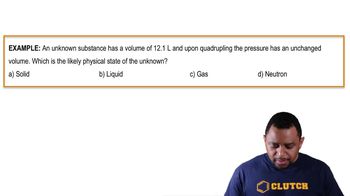
States of Matter Example 1