Pearson+ LogoPearson+ Logo
Ch.1 Matter and Measurements
McMurry - Fundamentals of GOB 8th Edition
McMurry8th EditionFundamentals of GOBISBN: 9780134015187Not the one you use?Change textbook
Chapter 1, Problem 21

Assuming that Coca-Cola has the same specific heat as water, how much energy in calories is removed when 350 g of Coca-Cola (about the contents of one 12 oz can) is cooled from room temperature (25 °C) to refrigerator temperature (3 °C)?

Verified step by step guidance
1
Step 1: Recall the formula for calculating heat energy: Q = m × c × ΔT, where Q is the heat energy, m is the mass, c is the specific heat capacity, and ΔT is the change in temperature.
Step 2: Identify the given values: mass m = 350 \, g, specific heat capacity of water c = 1.00 \, cal/(g \, °C), initial temperature T_{initial} = 25 \, °C, and final temperature T_{final} = 3 \, °C.
Step 3: Calculate the temperature change ΔT using the formula ΔT = T_{final} - T_{initial}. Substitute the values: ΔT = 3 \, °C - 25 \, °C.
Step 4: Substitute the values for m, c, and ΔT into the heat energy formula Q = m × c × ΔT. This becomes Q = 350 \, g × 1.00 \, cal/(g \, °C) × ΔT.
Step 5: Simplify the expression to find the total heat energy Q. Remember that the result will be in calories, and the negative sign indicates that energy is being removed (cooled).

Verified video answer for a similar problem:

This video solution was recommended by our tutors as helpful for the problem above.
Video duration:
1m
Was this helpful?

Key Concepts

Here are the essential concepts you must grasp in order to answer the question correctly.

Specific Heat Capacity

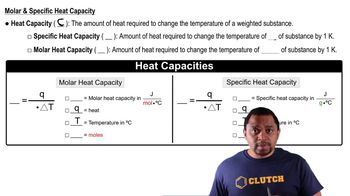
Specific heat capacity is the amount of heat energy required to raise the temperature of a unit mass of a substance by one degree Celsius. For this problem, it is assumed that Coca-Cola has the same specific heat as water, which is approximately 1 cal/g°C. This concept is crucial for calculating the energy change when the temperature of a substance changes.
Recommended video:
Guided course
02:19
Heat Capacity

Heat Transfer

Heat transfer refers to the movement of thermal energy from one object or substance to another due to a temperature difference. In this scenario, energy is removed from Coca-Cola as it cools down from room temperature to refrigerator temperature, which involves calculating the heat lost using the formula Q = mcΔT, where Q is the heat energy, m is the mass, c is the specific heat, and ΔT is the change in temperature.
Recommended video:
Guided course
02:19
Heat Capacity

Temperature Change

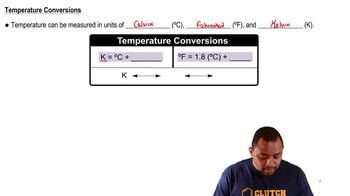
Temperature change is the difference in temperature between two states of a substance. In this case, the temperature change (ΔT) is calculated by subtracting the final temperature (3 °C) from the initial temperature (25 °C), resulting in a ΔT of 22 °C. This value is essential for determining the total energy removed from the Coca-Cola during the cooling process.
Recommended video:
Guided course
02:03
Temperature (Simplified) Concept 2