Pearson+ LogoPearson+ Logo
Ch.2 Atoms and the Periodic Table
McMurry - Fundamentals of GOB 8th Edition
McMurry8th EditionFundamentals of GOBISBN: 9780134015187Not the one you use?Change textbook
Chapter 2, Problem 15

An element has completely filled n = 1 and n = 2 shells and has six electrons in the n = 3 shell. Identify the element and its major group (i.e., main group, transition, etc.). Is it a metal or a nonmetal? Identify the orbital in which the last electron is found.

Verified step by step guidance
1
Step 1: Determine the total number of electrons in the element. The n = 1 shell can hold a maximum of 2 electrons, and the n = 2 shell can hold a maximum of 8 electrons. Since both shells are completely filled, this accounts for 2 + 8 = 10 electrons. Additionally, the n = 3 shell has 6 electrons, bringing the total to 10 + 6 = 16 electrons.
Step 2: Use the total number of electrons to identify the element. The atomic number of an element corresponds to the number of electrons in a neutral atom. An element with 16 electrons has an atomic number of 16, which corresponds to sulfur (S) on the periodic table.
Step 3: Determine the major group of the element. Sulfur is located in Group 16 (or VIA) of the periodic table, which is part of the main group elements. Group 16 elements are also known as the chalcogens.
Step 4: Classify the element as a metal or nonmetal. Sulfur is a nonmetal because it is located on the right side of the periodic table and exhibits properties typical of nonmetals, such as high electronegativity and the ability to form covalent bonds.
Step 5: Identify the orbital in which the last electron is found. The n = 3 shell consists of the 3s, 3p, and 3d orbitals. Since sulfur has 6 electrons in the n = 3 shell, the first 2 electrons fill the 3s orbital, and the next 4 electrons occupy the 3p orbitals. Therefore, the last electron is found in a 3p orbital.

Verified video answer for a similar problem:

This video solution was recommended by our tutors as helpful for the problem above.
Video duration:
1m
Was this helpful?

Key Concepts

Here are the essential concepts you must grasp in order to answer the question correctly.

Electron Configuration

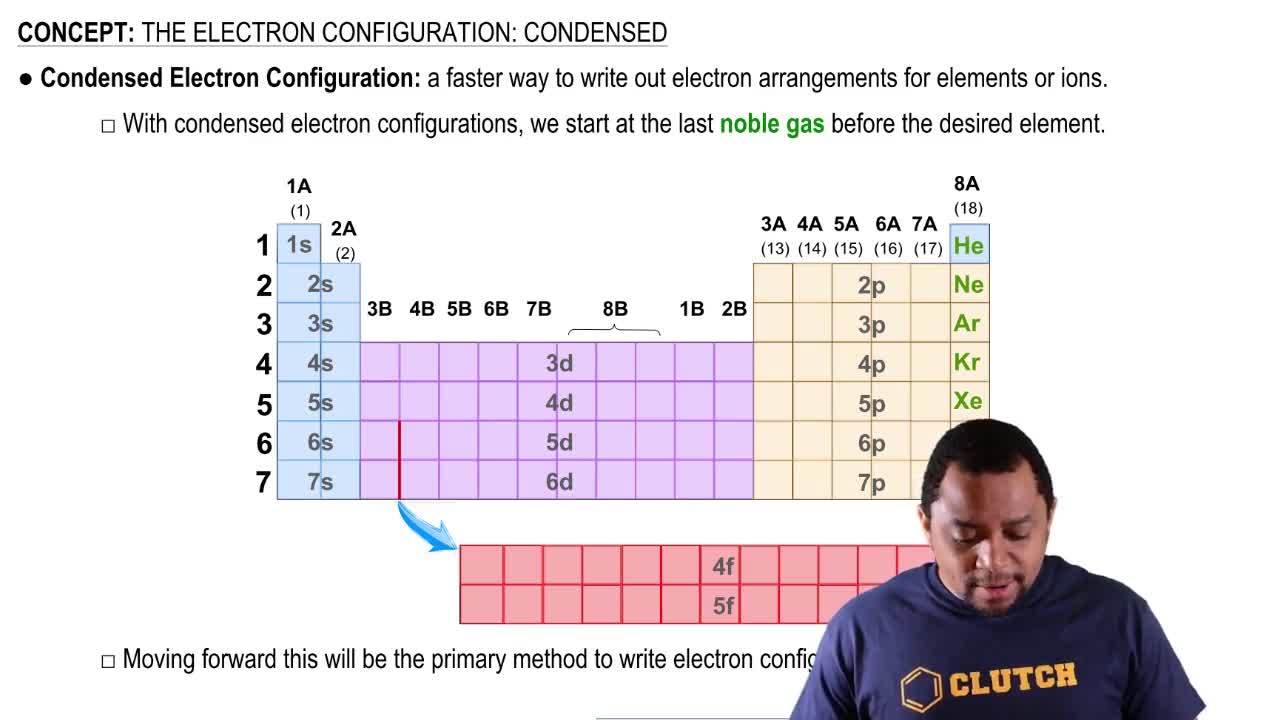
Electron configuration describes the distribution of electrons in an atom's orbitals. It is represented by a series of numbers and letters indicating the energy levels (n) and types of orbitals (s, p, d, f) occupied by electrons. For the given element, the filled n = 1 and n = 2 shells indicate a stable core, while the six electrons in the n = 3 shell suggest a specific arrangement that helps identify the element.
Recommended video:
Guided course
01:08
The Electron Configuration: Condensed

Periodic Table Groups

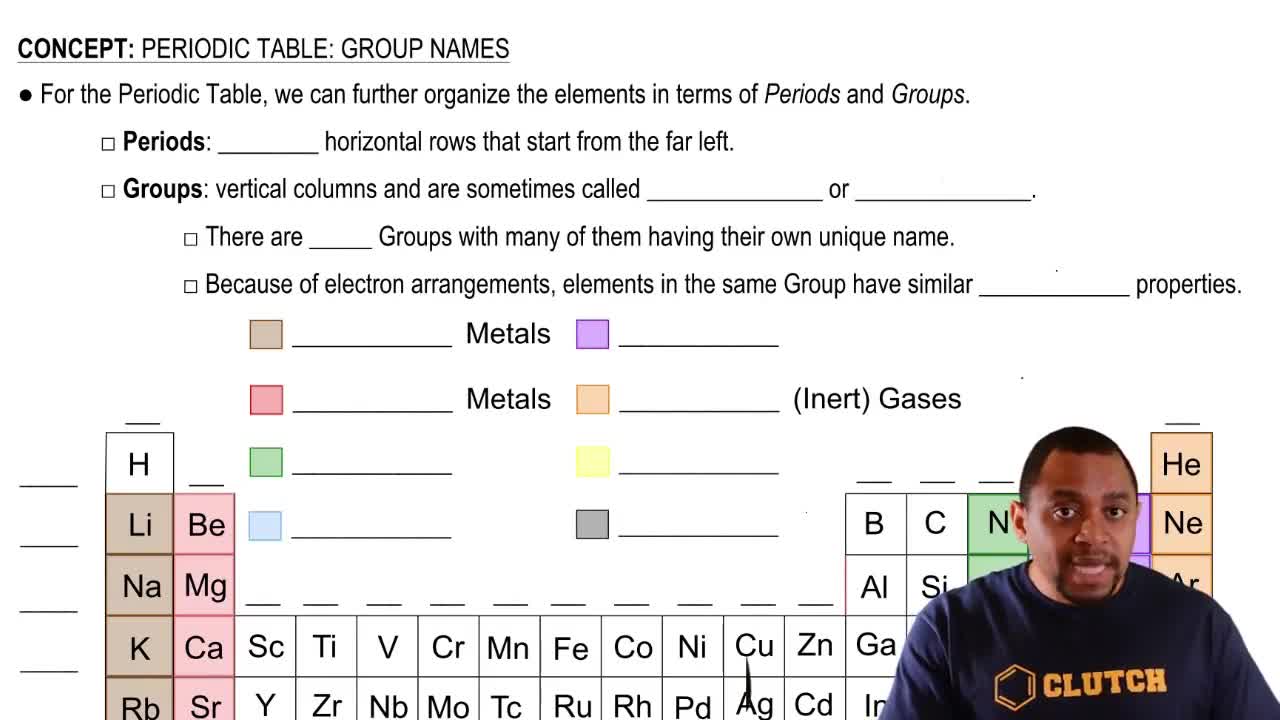
Elements are organized in the periodic table into groups based on their electron configurations and chemical properties. The major groups include main group elements (s and p block), transition metals (d block), and inner transition metals (f block). The number of valence electrons, which can be inferred from the outermost shell, helps determine the element's group and its metallic or nonmetallic character.
Recommended video:
Guided course
05:33
Periodic Table: Group Names

Metallic vs. Nonmetallic Character

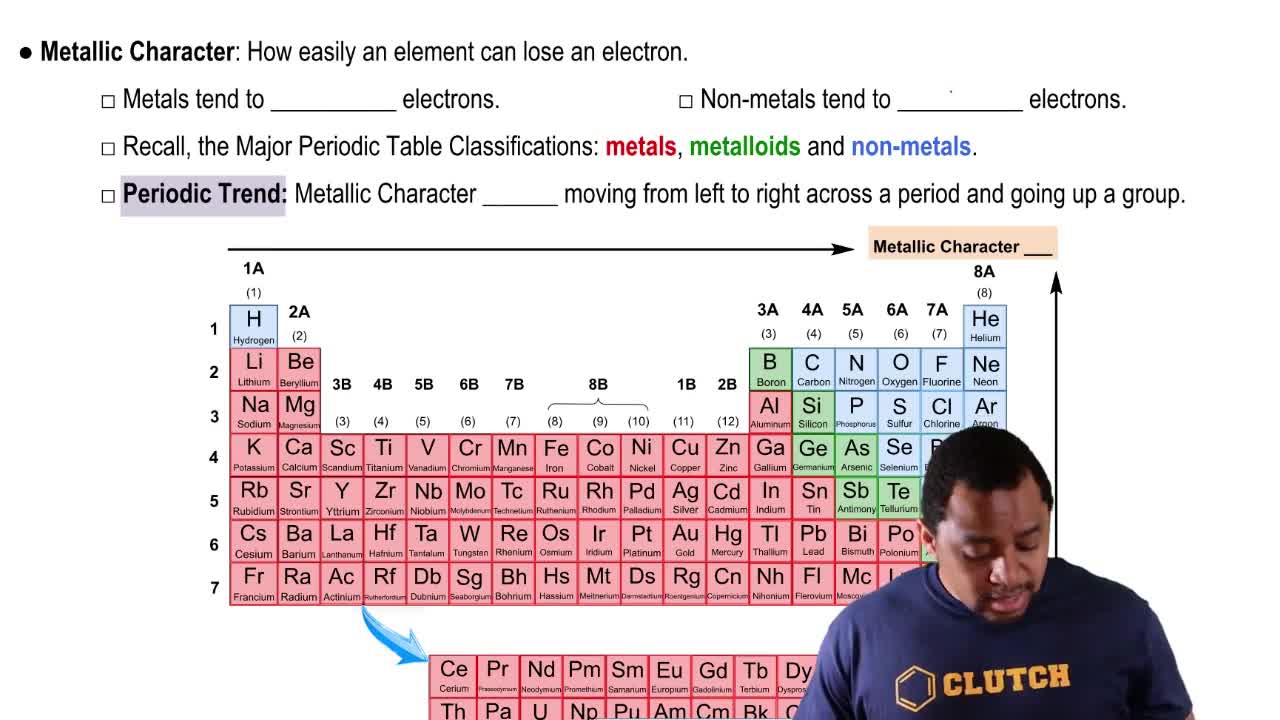
The distinction between metals and nonmetals is based on their physical and chemical properties. Metals are typically good conductors of heat and electricity, malleable, and ductile, while nonmetals are usually poor conductors and more brittle. The element in question, with six electrons in the n = 3 shell, is likely to be a nonmetal, specifically a member of the p block, where elements tend to exhibit nonmetallic characteristics.
Recommended video:
Guided course
01:08
Periodic Trend: Metallic Character