Pearson+ LogoPearson+ Logo
Ch.7 Chemical Reactions: Energy, Rate and Equilibrium
McMurry - Fundamentals of GOB 8th Edition
McMurry8th EditionFundamentals of GOBISBN: 9780134015187Not the one you use?Change textbook
Chapter 7, Problem 29a

Glucose, also known as "blood sugar" when measured in blood, has the formula C6H12O6.
a. Write the equation for the combustion of glucose with O2 to give CO2 and H2O.

Verified step by step guidance
1
Write the general form of a combustion reaction: A hydrocarbon or carbohydrate reacts with oxygen (O₂) to produce carbon dioxide (CO₂) and water (H₂O).
Write the unbalanced chemical equation for the combustion of glucose: C_6H_{12}O_6 + O_2 → CO_2 + H_2O.
Balance the carbon (C) atoms: Glucose has 6 carbon atoms, so place a coefficient of 6 in front of CO₂. The equation becomes: C_6H_{12}O_6 + O_2 → 6CO_2 + H_2O.
Balance the hydrogen (H) atoms: Glucose has 12 hydrogen atoms, so place a coefficient of 6 in front of H₂O. The equation becomes: C_6H_{12}O_6 + O_2 → 6CO_2 + 6H_2O.
Balance the oxygen (O) atoms: Count the total oxygen atoms on the product side (6CO₂ has 12 O atoms, and 6H₂O has 6 O atoms, for a total of 18 O atoms). Glucose contributes 6 O atoms, so you need 12 more O atoms from O₂. Place a coefficient of 6 in front of O₂. The balanced equation is: C_6H_{12}O_6 + 6O_2 → 6CO_2 + 6H_2O.

Verified video answer for a similar problem:

This video solution was recommended by our tutors as helpful for the problem above.
Video duration:
1m
Was this helpful?

Key Concepts

Here are the essential concepts you must grasp in order to answer the question correctly.

Combustion Reaction

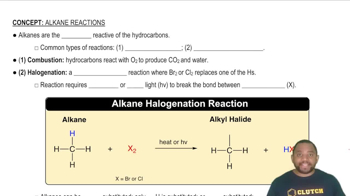
A combustion reaction is a chemical process in which a substance reacts rapidly with oxygen, producing heat and light. In the case of glucose, the combustion involves its reaction with oxygen to produce carbon dioxide and water, releasing energy. This type of reaction is fundamental in both biological processes, like cellular respiration, and in energy production.
Recommended video:
Guided course
2:25
Common Types of Alkane Reactions Concept 1

Chemical Equation

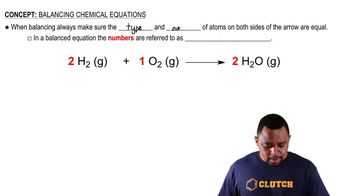
A chemical equation is a symbolic representation of a chemical reaction, showing the reactants and products along with their respective quantities. For the combustion of glucose, the equation illustrates how glucose (C6H12O6) and oxygen (O2) transform into carbon dioxide (CO2) and water (H2O). Balancing the equation is crucial to adhere to the law of conservation of mass.
Recommended video:
Guided course
01:32
Balancing Chemical Equations (Simplified) Concept 1

Stoichiometry

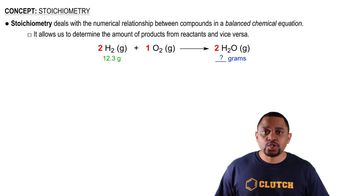
Stoichiometry is the branch of chemistry that deals with the quantitative relationships between the substances involved in a chemical reaction. It allows chemists to calculate the amounts of reactants needed and products formed. In the context of glucose combustion, stoichiometry helps in determining the correct coefficients for balancing the equation, ensuring that the number of atoms for each element is conserved.
Recommended video:
Guided course
01:16
Stoichiometry