Pearson+ LogoPearson+ Logo
Ch.7 Chemical Reactions: Energy, Rate and Equilibrium
McMurry - Fundamentals of GOB 8th Edition
McMurry8th EditionFundamentals of GOBISBN: 9780134015187Not the one you use?Change textbook
Chapter 7, Problem 25a

The vaporization of Br2 from the liquid to the gas state requires 7.4 kcal/mol (31.0 kJ/mol).
a. What is the sign of ∆H for this process? Write a reaction showing heat as a product or reactant.

Verified step by step guidance
1
Understand the concept of enthalpy change (∆H): Enthalpy change is the heat absorbed or released during a chemical or physical process at constant pressure. For endothermic processes, ∆H is positive, and for exothermic processes, ∆H is negative.
Identify the type of process: Vaporization is the process of converting a liquid into a gas. This requires energy input to overcome intermolecular forces, making it an endothermic process. Therefore, the sign of ∆H is positive.
Write the reaction for the vaporization of bromine (Br₂): The reaction can be written as Br₂(l) → Br₂(g).
Include heat in the reaction: Since the process is endothermic, heat is absorbed. Heat is written as a reactant in the reaction: Br₂(l) + heat → Br₂(g).
Summarize: The sign of ∆H for the vaporization of Br₂ is positive, and the reaction showing heat as a reactant is Br₂(l) + heat → Br₂(g).

Verified video answer for a similar problem:

This video solution was recommended by our tutors as helpful for the problem above.
Video duration:
51s
Was this helpful?

Key Concepts

Here are the essential concepts you must grasp in order to answer the question correctly.

Enthalpy Change (∆H)

Enthalpy change (∆H) is a measure of the heat content of a system during a process at constant pressure. A positive ∆H indicates that heat is absorbed from the surroundings, while a negative ∆H signifies that heat is released. In the context of vaporization, the process requires energy input, resulting in a positive ∆H.
Recommended video:
Guided course
01:17
Physical & Chemical Changes

Endothermic Process

An endothermic process is one that absorbs heat from its surroundings. In the case of vaporization, the transition of a substance from liquid to gas requires energy to overcome intermolecular forces. This absorption of heat is reflected in the positive value of ∆H, indicating that heat is a reactant in the reaction.
Recommended video:
Guided course
00:55
Endothermic & Exothermic Reactions Example 1

Chemical Reaction Representation

Chemical reactions can be represented with a balanced equation that includes reactants, products, and energy changes. For the vaporization of bromine (Br2), the reaction can be written as: Br2(l) + heat → Br2(g). This notation emphasizes that heat is required for the transition from liquid to gas, highlighting the endothermic nature of the process.
Recommended video:
Guided course
00:58
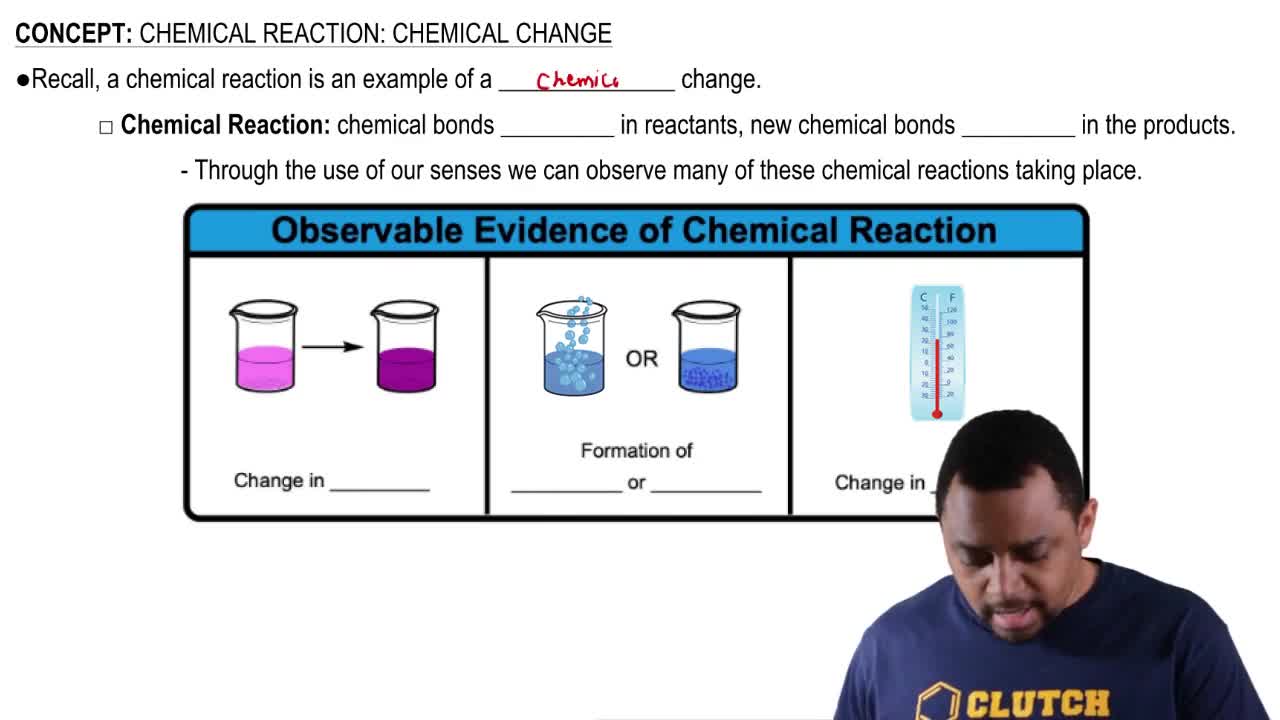
Chemical Reaction: Chemical Change Concept 1