Pearson+ LogoPearson+ Logo
Ch.7 Chemical Reactions: Energy, Rate and Equilibrium
McMurry - Fundamentals of GOB 8th Edition
McMurry8th EditionFundamentals of GOBISBN: 9780134015187Not the one you use?Change textbook
Chapter 7, Problem 22b

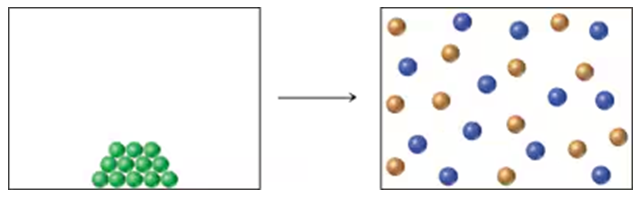
The following diagram portrays a reaction of the type A(s) → B(g) + C(g), where the different-colored spheres represent different molecular structures. Assume that the reaction has ∆H = +9.1 kcal/mol (+38.1 kJ/mol).

b. Is the reaction likely to be spontaneous at all temperatures, nonspontaneous at all temperatures, or spontaneous at some but nonspontaneous at others?

Verified step by step guidance
1
Step 1: Analyze the reaction type and the diagram. The reaction A(s) → B(g) + C(g) involves a solid reactant (A) breaking down into two gaseous products (B and C). The diagram shows the solid spheres (A) on the left transforming into dispersed spheres (B and C) on the right, indicating an increase in disorder or entropy (ΔS > 0).
Step 2: Recall the thermodynamic equation for spontaneity: ΔG = ΔH - TΔS. Here, ΔH is given as +9.1 kcal/mol (+38.1 kJ/mol), which is positive, indicating the reaction is endothermic. ΔS is positive due to the increase in entropy as the solid reactant forms gaseous products.
Step 3: Consider the temperature dependence of spontaneity. For an endothermic reaction (ΔH > 0) with a positive ΔS, the term -TΔS becomes more negative as temperature (T) increases. At high temperatures, the negative contribution of -TΔS can outweigh the positive ΔH, making ΔG negative and the reaction spontaneous.
Step 4: Evaluate the spontaneity at low temperatures. At low temperatures, the positive ΔH dominates because the -TΔS term is small, resulting in a positive ΔG. Therefore, the reaction is nonspontaneous at low temperatures.
Step 5: Conclude the temperature dependence. The reaction is spontaneous at high temperatures due to the favorable entropy change and nonspontaneous at low temperatures due to the endothermic nature of the reaction. Thus, the reaction is spontaneous at some temperatures but nonspontaneous at others.

Verified video answer for a similar problem:

This video solution was recommended by our tutors as helpful for the problem above.
Video duration:
3m
Was this helpful?

Key Concepts

Here are the essential concepts you must grasp in order to answer the question correctly.

Enthalpy (∆H)

Enthalpy is a thermodynamic property that reflects the total heat content of a system. In the context of a chemical reaction, the change in enthalpy (∆H) indicates whether the reaction absorbs or releases heat. A positive ∆H, such as +9.1 kcal/mol, signifies that the reaction is endothermic, meaning it requires heat input to proceed, which can affect its spontaneity.
Recommended video:
Guided course
02:32
Bond Energy Example 1

Spontaneity of Reactions

The spontaneity of a reaction refers to its ability to occur without external intervention. It is determined by the Gibbs free energy change (∆G), which combines enthalpy and entropy changes. A reaction is spontaneous if ∆G is negative, which can occur at certain temperatures depending on the balance between enthalpy and entropy, especially in endothermic reactions.

Entropy (S)

Entropy is a measure of the disorder or randomness in a system. In chemical reactions, an increase in entropy (positive ∆S) generally favors spontaneity, as systems tend to evolve towards greater disorder. In the given reaction, the transition from solid A to gaseous products B and C suggests an increase in entropy, which can contribute to the reaction's spontaneity at higher temperatures despite its positive enthalpy.
Recommended video:
Guided course
03:22
Entropy (Simplified) Concept 2