Pearson+ LogoPearson+ Logo
Ch.8 Gases, Liquids and Solids
McMurry - Fundamentals of GOB 8th Edition
McMurry8th EditionFundamentals of GOBISBN: 9780134015187Not the one you use?Change textbook
Chapter 8, Problem 97

List three kinds of crystalline solids, and give an example of each.

Verified step by step guidance
1
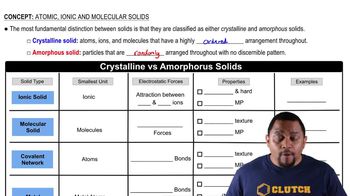
Identify the three main types of crystalline solids: ionic solids, molecular solids, and covalent network solids. These classifications are based on the types of particles and forces holding the solid together.
For ionic solids, explain that they are composed of positive and negative ions held together by strong ionic bonds. An example of an ionic solid is sodium chloride (NaCl).
For molecular solids, describe that they consist of molecules held together by intermolecular forces such as hydrogen bonding, dipole-dipole interactions, or London dispersion forces. An example of a molecular solid is ice (H₂O).
For covalent network solids, clarify that they are composed of atoms connected by a continuous network of covalent bonds, resulting in very hard and high-melting-point materials. An example of a covalent network solid is diamond (a form of carbon, C).
Summarize the three types of crystalline solids and their examples: ionic solids (e.g., NaCl), molecular solids (e.g., H₂O), and covalent network solids (e.g., diamond).

Verified video answer for a similar problem:

This video solution was recommended by our tutors as helpful for the problem above.
Video duration:
6m
Was this helpful?

Key Concepts

Here are the essential concepts you must grasp in order to answer the question correctly.

Ionic Crystalline Solids

Ionic crystalline solids are formed by the electrostatic attraction between positively and negatively charged ions. These solids typically have high melting and boiling points due to the strong ionic bonds. A common example is sodium chloride (NaCl), which forms a cubic lattice structure.
Recommended video:
Guided course
04:14
Atomic, Ionic and Molecular Solids Concept 1

Covalent Network Solids

Covalent network solids consist of atoms connected by a network of covalent bonds, resulting in a rigid structure. These solids are characterized by their high melting points and hardness. An example is diamond, where each carbon atom is tetrahedrally bonded to four other carbon atoms.
Recommended video:
Guided course
04:14
Atomic, Ionic and Molecular Solids Concept 1

Metallic Crystalline Solids

Metallic crystalline solids are composed of metal atoms that share a 'sea of electrons,' allowing for conductivity and malleability. The metallic bonds provide strength and flexibility. An example is copper, which is widely used in electrical wiring due to its excellent conductivity.
Recommended video:
Guided course
04:14
Atomic, Ionic and Molecular Solids Concept 1