Pearson+ LogoPearson+ Logo
Ch.8 Gases, Liquids and Solids
McMurry - Fundamentals of GOB 8th Edition
McMurry8th EditionFundamentals of GOBISBN: 9780134015187Not the one you use?Change textbook
Chapter 8, Problem 91

What is a liquid's heat of vaporization?

Verified step by step guidance
1
The heat of vaporization is the amount of energy required to convert one mole (or one gram, depending on the units) of a liquid into a gas at its boiling point, without changing its temperature.
This process involves breaking the intermolecular forces (such as hydrogen bonds, dipole-dipole interactions, or London dispersion forces) that hold the liquid molecules together.
The heat of vaporization is typically expressed in units of joules per mole (J/mol) or calories per gram (cal/g).
To calculate the heat of vaporization, you can use the formula: q = n × ΔHvap, where q is the heat absorbed, n is the number of moles, and ΔHvap is the molar heat of vaporization.
The heat of vaporization is a critical property in understanding phase changes and is used in applications such as distillation, refrigeration, and understanding the energy requirements of evaporation.

Verified video answer for a similar problem:

This video solution was recommended by our tutors as helpful for the problem above.
Video duration:
2m
Was this helpful?

Key Concepts

Here are the essential concepts you must grasp in order to answer the question correctly.

Heat of Vaporization

The heat of vaporization is the amount of energy required to convert a unit mass of a liquid into vapor without a change in temperature. This process occurs at the boiling point of the liquid and is crucial for understanding phase changes. It reflects the strength of intermolecular forces within the liquid; stronger forces result in a higher heat of vaporization.
Recommended video:
Guided course
02:19
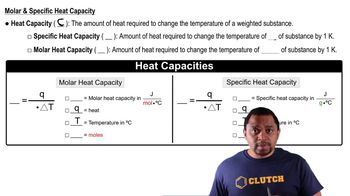
Heat Capacity

Intermolecular Forces

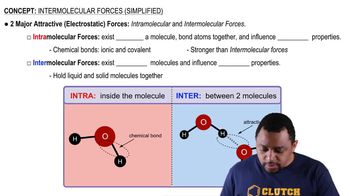
Intermolecular forces are the forces of attraction or repulsion between neighboring particles (atoms, molecules, or ions). These forces play a significant role in determining the physical properties of substances, including boiling points and heat of vaporization. Types of intermolecular forces include hydrogen bonding, dipole-dipole interactions, and London dispersion forces, with hydrogen bonds being the strongest.
Recommended video:
Guided course
01:59
Intermolecular Forces (Simplified) Concept 1

Phase Change

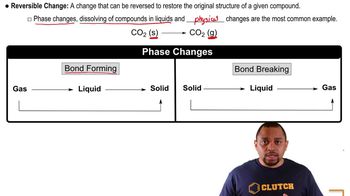
A phase change refers to the transition of a substance from one state of matter to another, such as from liquid to gas during vaporization. This process involves energy transfer, where heat is absorbed or released. Understanding phase changes is essential for grasping concepts like heat of vaporization, as it highlights how energy influences the state of a substance.
Recommended video:
Guided course
03:40
Physical & Chemical Changes