Pearson+ LogoPearson+ Logo
Ch.8 Gases, Liquids and Solids
McMurry - Fundamentals of GOB 8th Edition
McMurry8th EditionFundamentals of GOBISBN: 9780134015187Not the one you use?Change textbook
Chapter 8, Problem 100

Use the kinetic–molecular theory to explain why gas pressure increases if the temperature is raised and the volume is kept constant.

Verified step by step guidance
1
The kinetic–molecular theory states that gas particles are in constant, random motion and that their collisions with the walls of the container create pressure.
When the temperature of a gas increases, the average kinetic energy of the gas particles also increases. This is because temperature is directly proportional to the kinetic energy of the particles.
As the kinetic energy of the particles increases, they move faster and collide with the walls of the container more frequently and with greater force.
Since the volume is kept constant, the gas particles have less space to move, which means the increased frequency and force of collisions directly result in a higher pressure.
In summary, the increase in temperature leads to an increase in the kinetic energy of gas particles, which causes more frequent and forceful collisions with the container walls, thereby increasing the gas pressure.

Verified video answer for a similar problem:

This video solution was recommended by our tutors as helpful for the problem above.
Video duration:
1m
Was this helpful?

Key Concepts

Here are the essential concepts you must grasp in order to answer the question correctly.

Kinetic-Molecular Theory

The kinetic-molecular theory describes the behavior of gases in terms of particles in constant motion. It posits that gas particles are small, widely spaced, and move randomly at high speeds. This theory helps explain how temperature, pressure, and volume are interrelated in gaseous systems.
Recommended video:
Guided course
01:19
Kinetic Molecular Theory Concept 1

Gas Pressure

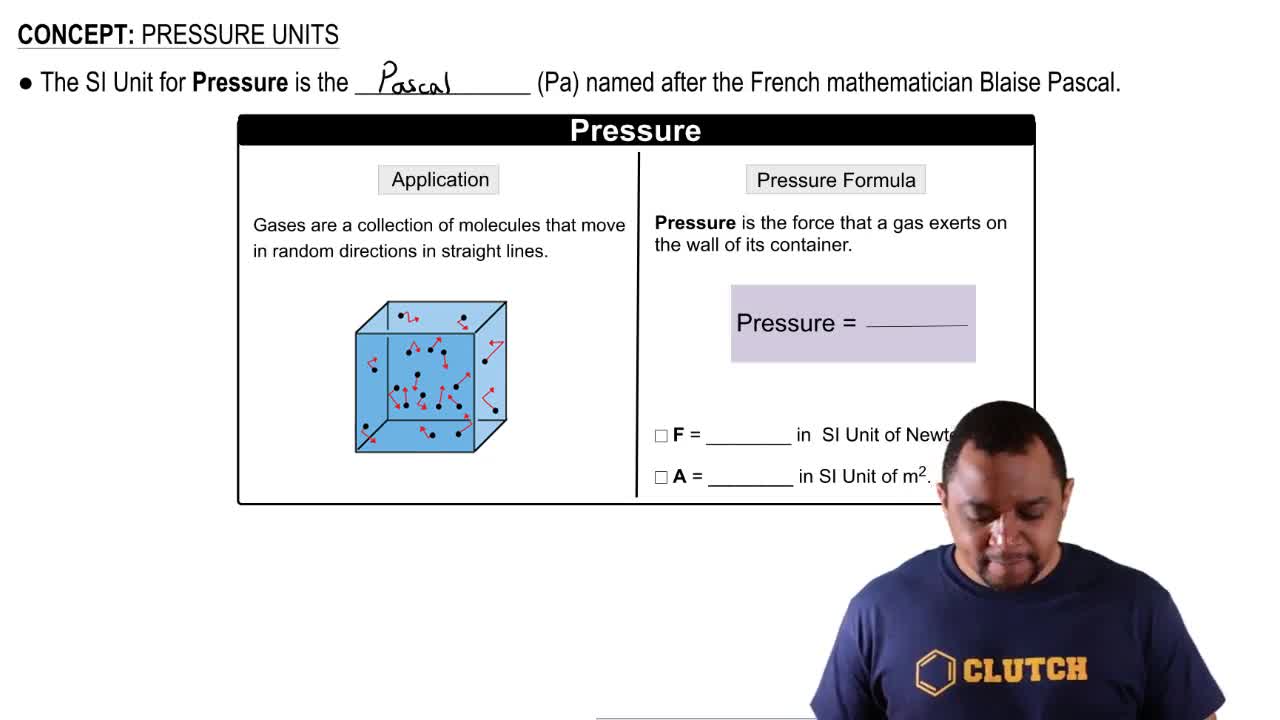
Gas pressure is defined as the force exerted by gas particles colliding with the walls of their container. When the temperature of a gas increases, the kinetic energy of the particles also increases, leading to more frequent and forceful collisions with the container walls, which results in higher pressure.
Recommended video:
Guided course
01:15
Pressure Units Concept 1

Charles's Law

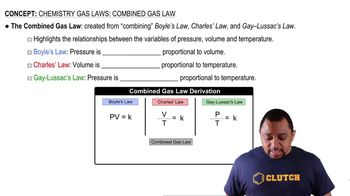
Charles's Law states that the volume of a gas is directly proportional to its temperature when pressure is held constant. However, in this scenario, since the volume is constant, an increase in temperature leads to an increase in pressure, as described by the ideal gas law, which combines these relationships.
Recommended video:
Guided course
01:43
Chemistry Gas Laws: Combined Gas Law