Pearson+ LogoPearson+ Logo
Ch.13 Alkenes, Alkynes, and Aromatic Compounds
McMurry - Fundamentals of GOB 8th Edition
McMurry8th EditionFundamentals of GOBISBN: 9780134015187Not the one you use?Change textbook
Chapter 13, Problem 55

If bromocyclohexane were converted into cyclohexene, what kind of reaction would that be?

Verified step by step guidance
1
Identify the starting material and the product: Bromocyclohexane is the starting material, and cyclohexene is the product.
Recognize the functional groups involved: Bromocyclohexane contains a bromine atom attached to a cyclohexane ring, while cyclohexene is a cyclohexane ring with a double bond.
Determine the type of reaction: The conversion involves the removal of a bromine atom and the formation of a double bond, which is characteristic of an elimination reaction.
Consider the mechanism: This is likely an E2 elimination reaction, where a base abstracts a proton adjacent to the carbon bearing the bromine, leading to the formation of a double bond and the expulsion of the bromide ion.
Summarize the reaction type: The conversion of bromocyclohexane to cyclohexene is an elimination reaction, specifically an E2 mechanism.

Verified video answer for a similar problem:

This video solution was recommended by our tutors as helpful for the problem above.
Was this helpful?

Key Concepts

Here are the essential concepts you must grasp in order to answer the question correctly.

Elimination Reaction

An elimination reaction is a type of chemical reaction where a molecule loses atoms or groups of atoms, resulting in the formation of a double bond or a ring structure. In the case of converting bromocyclohexane to cyclohexene, the reaction involves the removal of a bromine atom and a hydrogen atom, leading to the formation of a carbon-carbon double bond.
Recommended video:
Guided course
1:13
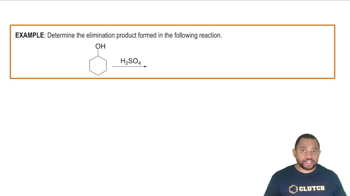
Alcohol Reactions Dehydration Reactions Example 1

Dehydrohalogenation

Dehydrohalogenation is a specific type of elimination reaction where a hydrogen halide (like HBr) is removed from a haloalkane. This process is crucial in the conversion of bromocyclohexane to cyclohexene, as it involves the elimination of bromine and a hydrogen atom, resulting in the formation of an alkene.
Recommended video:
Guided course
0:56
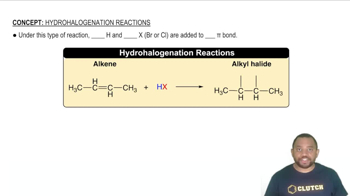
Hydrohalogenation Reaction Concept 1

Zaitsev's Rule

Zaitsev's Rule states that in elimination reactions, the more substituted alkene is typically the major product. This principle helps predict the outcome of the reaction when converting bromocyclohexane to cyclohexene, as the stability of the resulting alkene can influence the reaction pathway and product distribution.
Recommended video:
Guided course
1:24
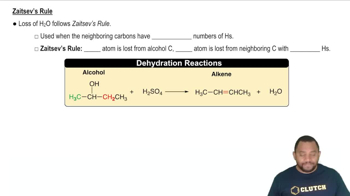
Zaitsev’s Rule Concept 2