Pearson+ LogoPearson+ Logo
Ch.13 Alkenes, Alkynes, and Aromatic Compounds
McMurry - Fundamentals of GOB 8th Edition
McMurry8th EditionFundamentals of GOBISBN: 9780134015187Not the one you use?Change textbook
Chapter 13, Problem 60a

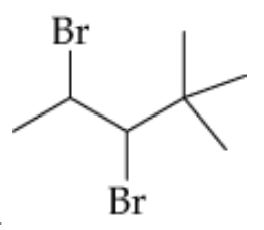
What alkene could you use to make the following products? Draw the structure of the alkene, and tell what other reagent is also required for the reaction to occur.
a. Chemical structure of a dibrominated alkene, illustrating halogenation reaction with bromine atoms attached.

Verified step by step guidance
1
Step 1: Understand the reaction type. The problem involves identifying the alkene and reagent needed to produce a specific product. This suggests a reaction mechanism such as an addition reaction, where an alkene reacts with a reagent to form the product.
Step 2: Analyze the product structure. Examine the product (represented by the image) to determine the functional groups and connectivity of atoms. Look for features such as hydroxyl groups, halogens, or other substituents that indicate the type of addition reaction.
Step 3: Work backward to deduce the alkene. Remove the added groups (e.g., halogens, hydroxyls) from the product to reconstruct the original alkene structure. This is the reverse of the addition reaction.
Step 4: Identify the reagent. Based on the functional groups added to the product, determine the reagent required. For example, if the product contains a hydroxyl group, the reagent might be water (H₂O) in the presence of an acid catalyst. If a halogen is present, the reagent could be a halogen molecule (e.g., Br₂ or Cl₂).
Step 5: Draw the structure of the alkene and specify the reagent. Represent the alkene using a structural formula and clearly state the reagent needed for the reaction to occur. Ensure the structure aligns with the product and reaction mechanism.

Verified video answer for a similar problem:

This video solution was recommended by our tutors as helpful for the problem above.
Was this helpful?

Key Concepts

Here are the essential concepts you must grasp in order to answer the question correctly.

Alkenes

Alkenes are hydrocarbons that contain at least one carbon-carbon double bond (C=C). They are unsaturated compounds, meaning they have fewer hydrogen atoms than alkanes with the same number of carbon atoms. Alkenes are reactive and can undergo various chemical reactions, including addition reactions, where other atoms or groups are added across the double bond.
Recommended video:
Guided course
3:26
Naming Alkenes Example 1

Addition Reactions

Addition reactions are a type of chemical reaction where two or more reactants combine to form a single product. In the context of alkenes, these reactions often involve the addition of halogens, hydrogen, or water across the double bond. Understanding the specific conditions and reagents required for these reactions is crucial for predicting the products formed from a given alkene.
Recommended video:
Guided course
2:55
Addition Reactions Concept 1

Reagents

Reagents are substances that are added to a chemical reaction to cause a change or to facilitate the reaction. In the case of alkenes, common reagents include hydrogen (for hydrogenation), halogens (for halogenation), and acids (for hydration). Identifying the correct reagent is essential for determining the products of the reaction and understanding the mechanism involved.
Recommended video:
Guided course
01:30
Limiting Reagent