Pearson+ LogoPearson+ Logo
Ch.13 Alkenes, Alkynes, and Aromatic Compounds
McMurry - Fundamentals of GOB 8th Edition
McMurry8th EditionFundamentals of GOBISBN: 9780134015187Not the one you use?Change textbook
Chapter 13, Problem 57

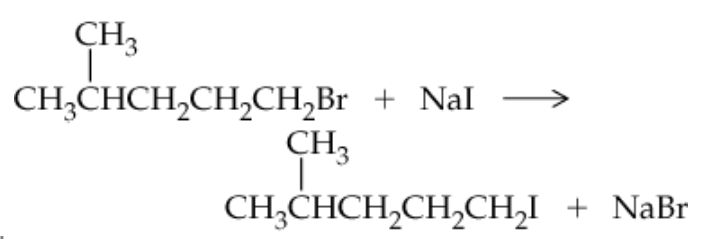
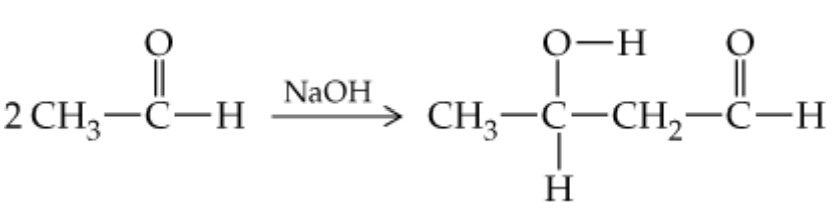
Identify the type of reaction for the following:
a. Chemical reaction showing the substitution of bromine with iodine in an alkane, producing sodium bromide.
b. Chemical reaction diagram showing the addition of NaOH to a compound, resulting in a new molecular structure.

Verified step by step guidance
1
Step 1: Understand the problem. The task is to identify the type of chemical reaction for each given reaction. Common types of reactions include synthesis (combination), decomposition, single replacement, double replacement, and combustion. Since the problem includes images, you would need to analyze the reactants and products in each reaction to classify them.
Step 2: For reaction (a), examine the reactants and products. If two or more reactants combine to form a single product, it is a synthesis reaction. If a single compound breaks down into two or more products, it is a decomposition reaction. If one element replaces another in a compound, it is a single replacement reaction. If two compounds exchange ions to form two new compounds, it is a double replacement reaction. If the reaction involves a hydrocarbon reacting with oxygen to produce carbon dioxide and water, it is a combustion reaction.
Step 3: For reaction (b), repeat the same analysis as in Step 2. Look at the reactants and products to determine the pattern of the reaction. Use the same criteria for identifying synthesis, decomposition, single replacement, double replacement, or combustion reactions.
Step 4: Compare the observed patterns in each reaction to the definitions of the reaction types. For example, if you see a metal reacting with a nonmetal to form an ionic compound, it is likely a synthesis reaction. If you see a compound breaking apart into simpler substances, it is a decomposition reaction.
Step 5: Once you have identified the reaction types for both (a) and (b), ensure your reasoning aligns with the observed chemical changes. Double-check the reactants and products to confirm your classification.

Verified video answer for a similar problem:

This video solution was recommended by our tutors as helpful for the problem above.
Was this helpful?

Key Concepts

Here are the essential concepts you must grasp in order to answer the question correctly.

Chemical Reactions

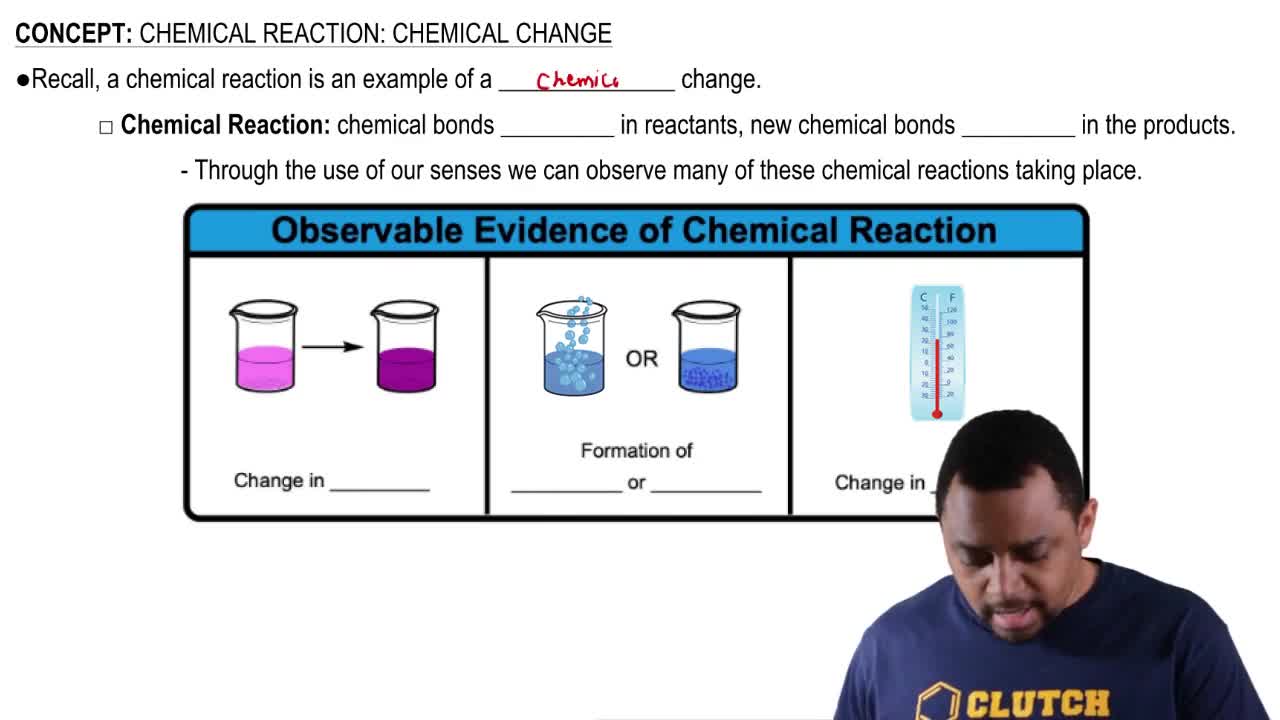
Chemical reactions involve the transformation of reactants into products through the breaking and forming of chemical bonds. Understanding the type of reaction—such as synthesis, decomposition, single replacement, or double replacement—requires knowledge of how atoms rearrange during these processes.
Recommended video:
Guided course
00:58
Chemical Reaction: Chemical Change Concept 1

Reaction Types

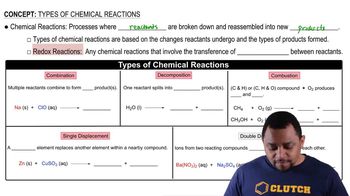
There are several main types of chemical reactions, including exothermic and endothermic reactions, which describe energy changes, and redox reactions, which involve the transfer of electrons. Identifying the type of reaction helps predict the behavior of substances and the energy changes involved.
Recommended video:
Guided course
04:07
Types of Chemical Reactions Concept 1

Balancing Chemical Equations

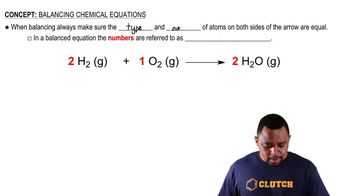
Balancing chemical equations is essential for accurately representing a chemical reaction. It ensures that the number of atoms for each element is conserved on both sides of the equation, which is a fundamental principle of chemistry. This skill is crucial for analyzing and understanding the stoichiometry of reactions.
Recommended video:
Guided course
01:32
Balancing Chemical Equations (Simplified) Concept 1