Pearson+ LogoPearson+ Logo
Ch.13 Alkenes, Alkynes, and Aromatic Compounds
McMurry - Fundamentals of GOB 8th Edition
McMurry8th EditionFundamentals of GOBISBN: 9780134015187Not the one you use?Change textbook
Chapter 13, Problem 13a

In the following addition reactions, are the given alkyl halides obtained as the major products? Give a reason for your answer.
a. 3-Chloro-3-ethylpentane from addition of HCl to 3-ethyl-2-pentene

Verified step by step guidance
1
Step 1: Identify the type of reaction. This is an electrophilic addition reaction where HCl adds across the double bond of 3-ethyl-2-pentene.
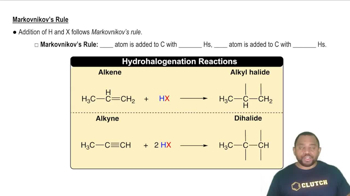
Step 2: Determine the Markovnikov's rule. According to Markovnikov's rule, in the addition of HX (where X is a halogen) to an alkene, the hydrogen atom (H) will attach to the carbon with more hydrogen atoms already bonded, and the halogen (Cl) will attach to the carbon with fewer hydrogen atoms.
Step 3: Analyze the structure of 3-ethyl-2-pentene. The double bond is between the second and third carbon atoms. The second carbon has two hydrogens, while the third carbon has one hydrogen.
Step 4: Apply Markovnikov's rule. The hydrogen from HCl will add to the second carbon (with more hydrogens), and the chlorine will add to the third carbon (with fewer hydrogens). This results in the formation of 3-chloro-3-ethylpentane.
Step 5: Confirm the product as the major product. Since the addition follows Markovnikov's rule, 3-chloro-3-ethylpentane is indeed the major product of this reaction.

Verified video answer for a similar problem:

This video solution was recommended by our tutors as helpful for the problem above.
Was this helpful?

Key Concepts

Here are the essential concepts you must grasp in order to answer the question correctly.

Markovnikov's Rule

Markovnikov's Rule states that in the addition of HX to an alkene, the hydrogen atom from HX will attach to the carbon with the greater number of hydrogen atoms already attached. This principle helps predict the major product of addition reactions, as it favors the formation of more stable carbocations.
Recommended video:
Guided course
1:37
Markovnikov's Rule Concept 2

Carbocation Stability

Carbocation stability is a key factor in determining the outcome of addition reactions. Tertiary carbocations are more stable than secondary or primary ones due to hyperconjugation and inductive effects. The stability of the carbocation intermediate influences which product is formed in the reaction.
Recommended video:
Guided course
02:26
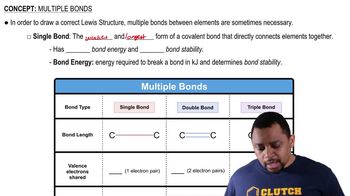
Multiple Bonds Concept 1

Regioselectivity

Regioselectivity refers to the preference of a chemical reaction to yield one structural isomer over others. In the context of alkene addition reactions, regioselectivity is influenced by factors such as carbocation stability and sterics, leading to the formation of major and minor products based on the most favorable pathway.