Pearson+ LogoPearson+ Logo
Ch.13 Alkenes, Alkynes, and Aromatic Compounds
McMurry - Fundamentals of GOB 8th Edition
McMurry8th EditionFundamentals of GOBISBN: 9780134015187Not the one you use?Change textbook
Chapter 13, Problem 16

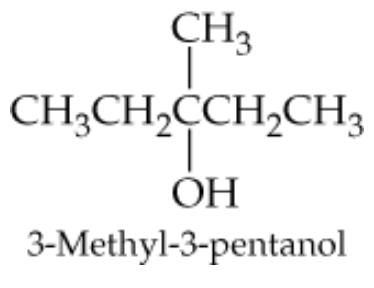
Draw the structures of the two different alkenes from which 3-methyl-3-pentanol, shown in the margin, can be made. Draw them in both condensed and line format.
Structural formula of 3-methyl-3-pentanol with labels for its components.

Verified step by step guidance
1
Identify the target molecule, 3-methyl-3-pentanol, and recognize that it is an alcohol with the hydroxyl group (-OH) attached to the third carbon of a pentane chain with a methyl group substituent on the same carbon.
Understand that the formation of 3-methyl-3-pentanol involves the addition of water (H₂O) across a double bond in an alkene. This reaction is called a hydration reaction, typically catalyzed by an acid.
Determine the possible positions of the double bond in the alkene that would lead to the formation of 3-methyl-3-pentanol. The double bond must be located such that the -OH group and the methyl group can attach to the same carbon (the third carbon).
Draw the structures of the two possible alkenes. In condensed format, these are: (1) CH₃-CH=C(CH₃)-CH₂-CH₃ and (2) CH₂=C(CH₃)-CH₂-CH₂-CH₃. In line format, represent the carbon skeletons with double bonds appropriately placed.
Verify that each alkene structure can undergo hydration to produce 3-methyl-3-pentanol. This involves ensuring that Markovnikov's rule is followed, where the -OH group attaches to the more substituted carbon of the double bond.

Verified video answer for a similar problem:

This video solution was recommended by our tutors as helpful for the problem above.
Video duration:
2m
Was this helpful?

Key Concepts

Here are the essential concepts you must grasp in order to answer the question correctly.

Alkenes

Alkenes are hydrocarbons that contain at least one carbon-carbon double bond (C=C). They are unsaturated compounds, meaning they have fewer hydrogen atoms than alkanes with the same number of carbon atoms. The presence of the double bond allows for unique reactivity, making alkenes important in organic synthesis, including the formation of alcohols like 3-methyl-3-pentanol.
Recommended video:
Guided course
3:26
Naming Alkenes Example 1

Condensed Structural Formula

A condensed structural formula is a way of representing a chemical structure that shows the arrangement of atoms in a molecule without depicting all the bonds explicitly. In this format, groups of atoms are grouped together, making it easier to visualize the molecular structure. For example, 3-methyl-3-pentanol can be represented as C5H12O, indicating its composition and functional groups.
Recommended video:
Guided course
1:53
Condensed Formula Concept 1

Line-Angle Structural Formula

The line-angle structural formula, also known as skeletal formula, is a simplified way of drawing organic molecules. In this representation, lines represent carbon-carbon bonds, and the ends of lines or intersections represent carbon atoms, while hydrogen atoms are usually omitted for clarity. This format is particularly useful for visualizing complex organic structures, such as the alkenes that can be converted into 3-methyl-3-pentanol.
Recommended video:
Guided course
1:01
Structural Formula Concept 2