Pearson+ LogoPearson+ Logo
Ch.13 Alkenes, Alkynes, and Aromatic Compounds
McMurry - Fundamentals of GOB 8th Edition
McMurry8th EditionFundamentals of GOBISBN: 9780134015187Not the one you use?Change textbook
Chapter 13, Problem 8a

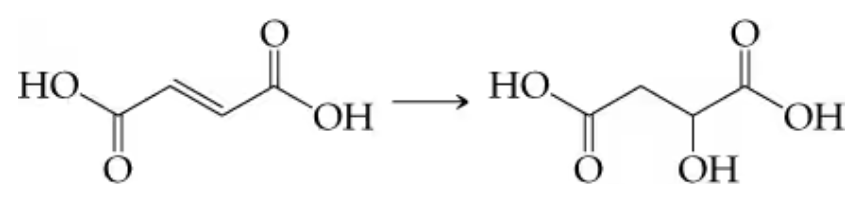
Many biological transformations can be simply classified as additions, eliminations, or substitutions. How would you classify the following reactions?
a. Fumaric acid to malic acid
Chemical reaction showing the conversion of fumaric acid to malic acid with structural formulas and bonds illustrated.

Verified step by step guidance
1
Step 1: Understand the reaction type. In this problem, we are tasked with classifying the reaction as an addition, elimination, or substitution. These terms refer to specific types of chemical transformations: (1) Addition involves adding atoms or groups to a molecule, (2) Elimination involves removing atoms or groups from a molecule, and (3) Substitution involves replacing one atom or group with another.
Step 2: Analyze the reactant and product. Fumaric acid is the reactant, and malic acid is the product. Examine the structural difference between these two molecules. Fumaric acid contains a double bond between two carbon atoms, while malic acid has a single bond between these carbons and an additional hydroxyl (-OH) group attached to one of them.
Step 3: Identify the transformation. The addition of the hydroxyl (-OH) group to one of the carbons in the double bond of fumaric acid results in the conversion of the double bond to a single bond. This indicates that atoms are being added to the molecule.
Step 4: Classify the reaction. Since the reaction involves the addition of a hydroxyl group to the double bond, this is classified as an 'addition reaction.'
Step 5: Relate to biological context. In the citric acid cycle, this reaction is catalyzed by the enzyme fumarase, which facilitates the hydration (addition of water) of fumaric acid to form malic acid. This is a specific example of an addition reaction in a biological system.

Verified video answer for a similar problem:

This video solution was recommended by our tutors as helpful for the problem above.
Was this helpful?

Key Concepts

Here are the essential concepts you must grasp in order to answer the question correctly.

Biological Transformations

Biological transformations refer to the chemical reactions that occur within living organisms, enabling them to convert substrates into products. These transformations are essential for metabolism, growth, and energy production. They can be categorized into three main types: additions, eliminations, and substitutions, which describe how molecular structures change during these reactions.
Recommended video:
Guided course
01:33
Alpha Decay Concept 2

Additions, Eliminations, and Substitutions

These terms describe the fundamental types of chemical reactions. An addition reaction involves the combination of two or more molecules to form a larger molecule, while an elimination reaction involves the removal of a small molecule from a larger one, resulting in a double bond. Substitution reactions occur when one atom or group in a molecule is replaced by another, altering the molecular structure without changing the overall number of atoms.
Recommended video:
Guided course
2:55
Addition Reactions Concept 1

Citric Acid Cycle

The citric acid cycle, also known as the Krebs cycle, is a key metabolic pathway that plays a crucial role in cellular respiration. It involves a series of enzymatic reactions that convert acetyl-CoA into carbon dioxide and high-energy electron carriers. The transformation of fumaric acid to malic acid is an example of a hydration reaction within this cycle, illustrating how biological transformations are integral to energy production in cells.
Recommended video:
Guided course
2:31
Citric Acid Cycle Summary Concept 12