Pearson+ LogoPearson+ Logo
Ch.13 Alkenes, Alkynes, and Aromatic Compounds
McMurry - Fundamentals of GOB 8th Edition
McMurry8th EditionFundamentals of GOBISBN: 9780134015187Not the one you use?Change textbook
Chapter 13, Problem 4

Which of the following substances exist as can cis–trans isomers? Draw both isomers for those that do.
a. 2,3-Dimethyl-2-pentene (condensed structures only)
b. 2-Methyl-2-hexene (both condensed and line structures)
c. 2-Hexene (line structures only)

Verified step by step guidance
1
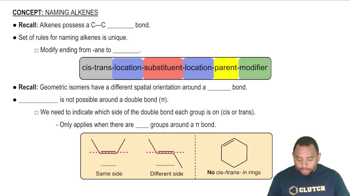
Step 1: Understand the concept of cis-trans isomerism. Cis-trans isomerism occurs in alkenes when there is restricted rotation around the double bond and two different groups are attached to each carbon of the double bond. For cis isomers, the similar groups are on the same side of the double bond, while for trans isomers, they are on opposite sides.
Step 2: Analyze the structure of 2,3-Dimethyl-2-pentene. The double bond is at the second carbon, and there are two methyl groups attached to the second and third carbons. Check if the carbons involved in the double bond have two different groups attached. If not, cis-trans isomerism is not possible.
Step 3: Analyze the structure of 2-Methyl-2-hexene. The double bond is at the second carbon, and there is a methyl group attached to the second carbon. Check if the carbons involved in the double bond have two different groups attached. If they do, draw both the cis and trans isomers in both condensed and line structures.
Step 4: Analyze the structure of 2-Hexene. The double bond is at the second carbon. Check if the carbons involved in the double bond have two different groups attached. If they do, draw both the cis and trans isomers in line structures.
Step 5: Summarize your findings. For each compound, determine whether cis-trans isomerism is possible based on the analysis. If it is, ensure you have drawn both the cis and trans isomers as specified in the problem (condensed or line structures).

Verified video answer for a similar problem:

This video solution was recommended by our tutors as helpful for the problem above.
Was this helpful?

Key Concepts

Here are the essential concepts you must grasp in order to answer the question correctly.

Cis-Trans Isomerism

Cis-trans isomerism, also known as geometric isomerism, occurs in compounds with restricted rotation around a double bond or a ring structure. In cis isomers, substituents are on the same side of the double bond, while in trans isomers, they are on opposite sides. This difference in spatial arrangement can significantly affect the physical and chemical properties of the compounds.
Recommended video:
Guided course
2:47
Rules for Naming Alkenes Concept 1

Alkenes and Their Structure

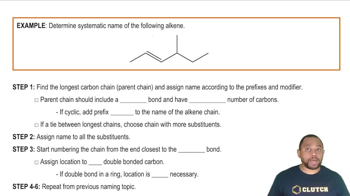
Alkenes are hydrocarbons that contain at least one carbon-carbon double bond (C=C). The presence of this double bond allows for the possibility of cis-trans isomerism, as the double bond restricts rotation. The structure of alkenes can be represented using condensed formulas or line structures, which visually depict the arrangement of atoms and bonds.
Recommended video:
Guided course
3:26
Naming Alkenes Example 1

Drawing Isomers

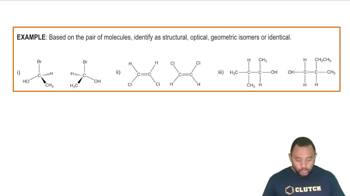
Drawing isomers involves representing the different spatial arrangements of atoms in a molecule. For cis-trans isomers, it is essential to accurately depict the positions of substituents around the double bond. This can be done using condensed structures, which show the connectivity of atoms, or line structures, which provide a clearer view of the molecular geometry and bond angles.
Recommended video:
Guided course
2:28
Isomers Example 1