Pearson+ LogoPearson+ Logo
Ch.13 Alkenes, Alkynes, and Aromatic Compounds
McMurry - Fundamentals of GOB 8th Edition
McMurry8th EditionFundamentals of GOBISBN: 9780134015187Not the one you use?Change textbook
Chapter 13, Problem 7

Classify the following reactions as an addition, elimination, or substitution:
a. CH3Br + NaOH → CH3OH + NaBr
b. H2C═CH2 + HCl → CH3CH2Cl
c. CH3CH2Br → H2C═CH2 + HBr

Verified step by step guidance
1
Step 1: Understand the three types of reactions: Addition reactions involve adding atoms or groups to a molecule, typically across a double or triple bond. Elimination reactions involve the removal of atoms or groups from a molecule, often resulting in the formation of a double or triple bond. Substitution reactions involve replacing one atom or group in a molecule with another.
Step 2: Analyze reaction (a): CH₃Br + NaOH → CH₃OH + NaBr. In this reaction, the bromine atom (Br) in CH₃Br is replaced by a hydroxyl group (OH) from NaOH, forming CH₃OH and NaBr. This is a substitution reaction.
Step 3: Analyze reaction (b): H₂C═CH₂ + HCl → CH₃CH₂Cl. Here, the double bond in ethene (H₂C═CH₂) is broken, and a hydrogen atom (H) and a chlorine atom (Cl) are added to the molecule, forming CH₃CH₂Cl. This is an addition reaction.
Step 4: Analyze reaction (c): CH₃CH₂Br → H₂C═CH₂ + HBr. In this reaction, a hydrogen atom (H) and a bromine atom (Br) are removed from CH₃CH₂Br, resulting in the formation of a double bond in H₂C═CH₂. This is an elimination reaction.
Step 5: Summarize the classifications: (a) is a substitution reaction, (b) is an addition reaction, and (c) is an elimination reaction. These classifications are based on the changes occurring in the reactants and products.

Verified video answer for a similar problem:

This video solution was recommended by our tutors as helpful for the problem above.
Was this helpful?

Key Concepts

Here are the essential concepts you must grasp in order to answer the question correctly.

Addition Reactions

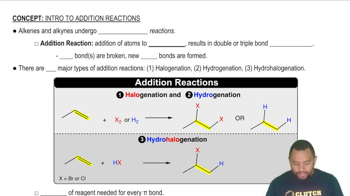
Addition reactions involve the combination of two or more reactants to form a single product. In these reactions, unsaturated compounds, such as alkenes or alkynes, react with other molecules, resulting in the formation of new bonds. A common example is the reaction of ethylene (H₂C═CH₂) with hydrogen chloride (HCl) to produce chloroethane (CH₃CH₂Cl).
Recommended video:
Guided course
2:55
Addition Reactions Concept 1

Elimination Reactions

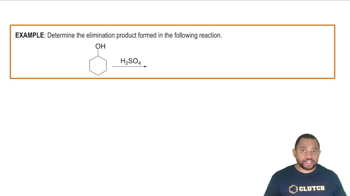
Elimination reactions occur when a single reactant breaks down into two products, typically involving the removal of a small molecule like water or hydrogen halide. These reactions often convert saturated compounds into unsaturated ones. For instance, the reaction of bromoethane (CH₃CH₂Br) to form ethylene (H₂C═CH₂) and hydrogen bromide (HBr) is a classic example of an elimination reaction.
Recommended video:
Guided course
1:13
Alcohol Reactions Dehydration Reactions Example 1

Substitution Reactions

Substitution reactions involve the replacement of one atom or group in a molecule with another atom or group. This type of reaction is common in organic chemistry, particularly with alkyl halides. An example is the reaction of methyl bromide (CH₃Br) with sodium hydroxide (NaOH), where the bromine atom is replaced by a hydroxyl group, resulting in methanol (CH₃OH) and sodium bromide (NaBr).
Recommended video:
Guided course
5:07
Naming Alkanes with Substituents Example 1