
Pearson+ LogoPearson+ Logo
Ch.14 Some Compounds with Oxygen, Sulfur, or a Halogen
McMurry - Fundamentals of GOB 8th Edition
McMurry8th EditionFundamentals of GOBISBN: 9780134015187Not the one you use?Change textbook
Chapter 14, Problem 38

Arrange the following 6-carbon compounds in order of their expected boiling points, and explain your ranking:
a. Hexane
b. 1-Hexanol
c. Dipropyl ether (CH3CH2CH2—O—CH2CH2CH3)

Verified step by step guidance
1
Step 1: Understand the factors affecting boiling points. Boiling points are influenced by intermolecular forces, such as London dispersion forces, dipole-dipole interactions, and hydrogen bonding. Stronger intermolecular forces result in higher boiling points.
Step 2: Analyze the structure of hexane (C₆H₁₄). Hexane is a nonpolar molecule with only London dispersion forces acting between its molecules. These forces are relatively weak compared to other types of intermolecular forces.
Step 3: Analyze the structure of 1-hexanol (C₆H₁₃OH). 1-Hexanol contains a hydroxyl group (-OH), which allows for hydrogen bonding between its molecules. Hydrogen bonding is a strong intermolecular force, so 1-hexanol is expected to have a higher boiling point than hexane.
Step 4: Analyze the structure of dipropyl ether (CH₃CH₂CH₂—O—CH₂CH₂CH₃). Dipropyl ether contains an oxygen atom, which creates a polar bond and allows for dipole-dipole interactions. However, it does not have hydrogen bonding because there are no hydrogen atoms directly bonded to the oxygen. Its boiling point is expected to be higher than hexane but lower than 1-hexanol.
Step 5: Rank the compounds based on their boiling points. Considering the strength of intermolecular forces: 1-hexanol (hydrogen bonding) > dipropyl ether (dipole-dipole interactions) > hexane (London dispersion forces).

Verified video answer for a similar problem:

This video solution was recommended by our tutors as helpful for the problem above.
Was this helpful?

Key Concepts

Here are the essential concepts you must grasp in order to answer the question correctly.

Boiling Point

The boiling point of a substance is the temperature at which its vapor pressure equals the external pressure, causing it to change from liquid to gas. Factors influencing boiling points include molecular weight, intermolecular forces, and molecular structure. Generally, stronger intermolecular forces lead to higher boiling points.
Recommended video:
Guided course
03:05
Boiling Point Elevation Concept 1

Intermolecular Forces

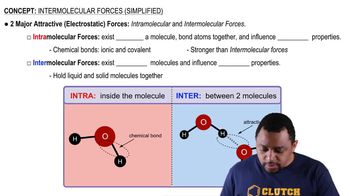
Intermolecular forces are the forces of attraction or repulsion between molecules. The main types include hydrogen bonding, dipole-dipole interactions, and London dispersion forces. Compounds with hydrogen bonding, like alcohols, typically have higher boiling points than those with only weaker forces, such as ethers or hydrocarbons.
Recommended video:
Guided course
01:59
Intermolecular Forces (Simplified) Concept 1

Molecular Structure

Molecular structure refers to the arrangement of atoms within a molecule, which affects its physical properties. For example, the presence of functional groups, such as hydroxyl (-OH) in alcohols, can significantly alter boiling points compared to hydrocarbons. The branching of carbon chains also influences boiling points, with more branched structures generally having lower boiling points.
Recommended video:
Guided course
00:34
Molecular Models Example 1