Pearson+ LogoPearson+ Logo
Ch.17 Carboxylic Acids and Their Derivatives
McMurry - Fundamentals of GOB 8th Edition
McMurry8th EditionFundamentals of GOBISBN: 9780134015187Not the one you use?Change textbook
Chapter 17, Problem 35b

Arrange these compounds in order of increasing boiling points and explain your rationale for the order.
(i) formic acid
(ii) methyl formate
(iii) formamide.

Verified step by step guidance
1
Identify the intermolecular forces present in each compound. Common forces include London dispersion forces, dipole-dipole interactions, and hydrogen bonding. Stronger intermolecular forces generally lead to higher boiling points.
Consider the molecular weight of each compound. Larger molecules with greater molecular weights tend to have higher boiling points due to increased London dispersion forces.
Examine the molecular structure of each compound. Linear molecules often have stronger London dispersion forces compared to branched molecules of similar molecular weight, which can influence boiling points.
Check for the presence of functional groups capable of hydrogen bonding (e.g., -OH, -NH). Compounds with hydrogen bonding typically have significantly higher boiling points than those without.
Arrange the compounds in order of increasing boiling points based on the strength of their intermolecular forces, molecular weight, and structural considerations. Provide a rationale for the order based on these factors.

Verified video answer for a similar problem:

This video solution was recommended by our tutors as helpful for the problem above.
Was this helpful?

Key Concepts

Here are the essential concepts you must grasp in order to answer the question correctly.

Intermolecular Forces

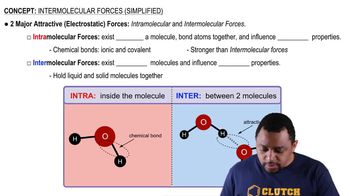
Intermolecular forces are the attractions between molecules that influence physical properties like boiling points. The main types include hydrogen bonding, dipole-dipole interactions, and London dispersion forces. Compounds with stronger intermolecular forces typically have higher boiling points because more energy is required to separate the molecules during the phase change from liquid to gas.
Recommended video:
Guided course
01:59
Intermolecular Forces (Simplified) Concept 1

Molecular Weight

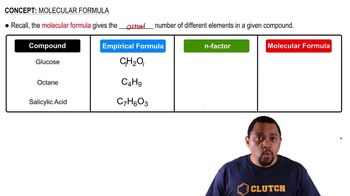
Molecular weight, or molar mass, refers to the mass of a molecule based on the sum of the atomic weights of its constituent atoms. Generally, as molecular weight increases, the boiling point also tends to increase due to the greater number of electrons, which enhances London dispersion forces. However, this trend can be influenced by the presence of functional groups and molecular structure.
Recommended video:
Guided course
02:08
Molecular Formula

Polarity

Polarity describes the distribution of electrical charge over the atoms in a molecule. Polar molecules have a significant difference in electronegativity between bonded atoms, leading to dipole-dipole interactions that can elevate boiling points. In contrast, nonpolar molecules primarily exhibit weaker London dispersion forces, resulting in lower boiling points. Understanding polarity is crucial for predicting the boiling point order of compounds.
Recommended video:
Guided course
01:34
Molecular Polarity (Simplified) Concept 1