
Pearson+ LogoPearson+ Logo
Ch.18 Amino Acids and Proteins
McMurry - Fundamentals of GOB 8th Edition
McMurry8th EditionFundamentals of GOBISBN: 9780134015187Not the one you use?Change textbook
Chapter 18, Problem 19

There are eight amino acids in vasopressin. How many peptide bonds are in this small protein?

Verified step by step guidance
1
Understand the structure of a peptide bond: A peptide bond is a covalent bond formed between the carboxyl group (-COOH) of one amino acid and the amino group (-NH2) of another amino acid during a condensation reaction, releasing a molecule of water (H2O).
Recognize that peptide bonds link amino acids together in a chain to form proteins or peptides. The number of peptide bonds in a protein is always one less than the number of amino acids in the chain.
Identify the number of amino acids in vasopressin, which is given as eight.
Subtract one from the total number of amino acids to determine the number of peptide bonds. This is because the first amino acid in the chain does not form a peptide bond at its amino terminus, and the last amino acid does not form a peptide bond at its carboxyl terminus.
Conclude that the number of peptide bonds in vasopressin is equal to the number of amino acids (8) minus one, which gives the result.

Verified video answer for a similar problem:

This video solution was recommended by our tutors as helpful for the problem above.
Was this helpful?

Key Concepts

Here are the essential concepts you must grasp in order to answer the question correctly.

Amino Acids

Amino acids are organic compounds that serve as the building blocks of proteins. Each amino acid consists of a central carbon atom, an amino group, a carboxyl group, a hydrogen atom, and a variable side chain (R group). In proteins, amino acids are linked together by peptide bonds to form polypeptides, which fold into functional proteins.
Recommended video:
Guided course
3:03
Amino Acid Catabolism: Amino Group Example 2

Peptide Bonds

Peptide bonds are covalent chemical bonds that link amino acids together in a protein. They form through a dehydration synthesis reaction, where the carboxyl group of one amino acid reacts with the amino group of another, releasing a molecule of water. Each peptide bond connects two amino acids, contributing to the protein's primary structure.
Recommended video:
Guided course
1:24
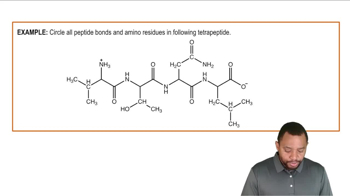
Peptides Example 1

Protein Structure

Protein structure refers to the three-dimensional arrangement of amino acids in a protein, which determines its function. The primary structure is the linear sequence of amino acids linked by peptide bonds. Understanding the number of amino acids helps in determining the number of peptide bonds, as each bond forms between two amino acids, leading to one less bond than the total number of amino acids.
Recommended video:
Guided course
3:26
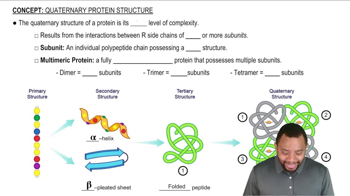
Quaternary Protein Structure Concept 1