
Pearson+ LogoPearson+ Logo
Ch.18 Amino Acids and Proteins
McMurry - Fundamentals of GOB 8th Edition
McMurry8th EditionFundamentals of GOBISBN: 9780134015187Not the one you use?Change textbook
Chapter 18, Problem 35a

Interactions of amino acids on the interior of proteins are key to the shapes of proteins. In group (a), which pairs of amino acids form hydrophobic interactions? In group (b), which pairs form ionic interactions? Which pairs in group (c) form hydrogen bonds?
a. 1 Pro . . . Phe
   2 Lys . . . Ser
   3 Thr . . . Leu
   4 Ala . . . Gly

Verified step by step guidance
1
Step 1: Understand the types of interactions mentioned in the problem. Hydrophobic interactions occur between nonpolar amino acid side chains, ionic interactions occur between oppositely charged side chains, and hydrogen bonds occur between polar side chains or backbone groups capable of donating or accepting hydrogen atoms.
Step 2: Analyze group (a) for hydrophobic interactions. Look for pairs of amino acids with nonpolar side chains. For example, Proline (Pro), Phenylalanine (Phe), Leucine (Leu), Alanine (Ala), and Glycine (Gly) are nonpolar and can form hydrophobic interactions.
Step 3: For group (b), identify pairs that can form ionic interactions. Ionic interactions occur between amino acids with charged side chains, such as Lysine (Lys, positively charged) and other amino acids with negatively charged side chains like Aspartate (Asp) or Glutamate (Glu). Check if any pairs in the problem fit this criterion.
Step 4: For group (c), determine pairs that can form hydrogen bonds. Hydrogen bonds occur between polar side chains or backbone groups. Amino acids like Serine (Ser) and Threonine (Thr) have hydroxyl groups (-OH) that can participate in hydrogen bonding. Check if any pairs in the problem involve these or similar polar groups.
Step 5: Summarize the findings for each group based on the interactions identified. Ensure you clearly categorize the pairs into hydrophobic, ionic, or hydrogen bonding interactions based on their chemical properties.

Key Concepts

Here are the essential concepts you must grasp in order to answer the question correctly.

Hydrophobic Interactions

Hydrophobic interactions occur between nonpolar amino acids in an aqueous environment, where they tend to cluster together to minimize their exposure to water. This phenomenon is crucial for protein folding, as it helps stabilize the protein's three-dimensional structure by driving nonpolar side chains inward, away from the water.
Recommended video:
Guided course
2:41
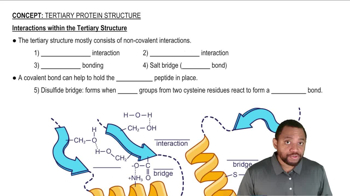
Interactions within the Tertiary Structure Concept 2

Ionic Interactions

Ionic interactions, also known as electrostatic interactions, occur between positively and negatively charged side chains of amino acids. These interactions are significant in stabilizing protein structures, as they can form strong attractions that help maintain the protein's conformation, especially in the presence of polar solvents.
Recommended video:
Guided course
02:33
Ionic Bonding Concept 1

Hydrogen Bonds

Hydrogen bonds are weak attractions that occur when a hydrogen atom covalently bonded to an electronegative atom, like oxygen or nitrogen, interacts with another electronegative atom. In proteins, these bonds are essential for maintaining secondary structures such as alpha helices and beta sheets, contributing to the overall stability and functionality of the protein.
Recommended video:
Guided course
1:22
Hydrogenation Reactions Concept 1
Related Practice
Textbook Question

Draw the structure of the following amino acids, dipeptides, and tripeptides at low pH (pH 1) and high pH (pH 14). At each pH, assume that all functional groups that might do so are ionized.

a. Val

20
views
Textbook Question

Draw the structure of the following amino acids, dipeptides, and tripeptides at low pH (pH 1) and high pH (pH 14). At each pH, assume that all functional groups that might do so are ionized.

d. Glu-Asp

194
views
Textbook Question

Draw the structure of the following amino acids, dipeptides, and tripeptides at low pH (pH 1) and high pH (pH 14). At each pH, assume that all functional groups that might do so are ionized.

e. Gln-Ala-Asn

290
views
Textbook Question

Draw the hexapeptide Asp-Gly-Phe-Leu-Glu-Ala in linear form showing all of the atoms, and show (using dotted lines) the hydrogen bonding that stabilizes this structure if it is part of an α-helix.

625
views
Textbook Question

Compare and contrast the characteristics of fibrous and globular proteins. Consider biological function, water solubility, amino acid composition, secondary structure, and tertiary structure. Give examples of three fibrous and three globular proteins. (Hint: Make a table.)

526
views
Textbook Question

Cell membranes are studded with proteins. Some of these proteins, involved in the transport of molecules across the membrane into the cell, span the entire membrane and are called transmembrane proteins. The interior of the cell membrane is hydrophobic and nonpolar, whereas both the extracellular and intracellular fluids are water-based.

a. List three amino acids you would expect to find in the part of a transmembrane protein that lies within the cell membrane.

849
views