Pearson+ LogoPearson+ Logo
Ch.19 Enzymes and Vitamins
McMurry - Fundamentals of GOB 8th Edition
McMurry8th EditionFundamentals of GOBISBN: 9780134015187Not the one you use?Change textbook
Chapter 19, Problem 44b

What kind of reaction does each of these enzymes catalyze?
b. A transmethylase

Verified step by step guidance
1
Understand the role of enzymes: Enzymes are biological catalysts that speed up chemical reactions in living organisms. Each enzyme is specific to a particular type of reaction.
Identify the type of enzyme: A 'transmethylase' is a specific type of enzyme that catalyzes the transfer of a methyl group (−CH₃) from one molecule to another.
Define the reaction type: The reaction catalyzed by a transmethylase is classified as a 'transferase' reaction. Transferases are enzymes that transfer functional groups (e.g., methyl, phosphate) between molecules.
Provide an example: For instance, a transmethylase might transfer a methyl group from S-adenosylmethionine (SAM) to a substrate molecule, which is a common reaction in biological methylation processes.
Summarize the function: Transmethylases are crucial in processes like DNA methylation, which regulates gene expression, and in the metabolism of various biomolecules.

Verified video answer for a similar problem:

This video solution was recommended by our tutors as helpful for the problem above.
Video duration:
1m
Was this helpful?

Key Concepts

Here are the essential concepts you must grasp in order to answer the question correctly.

Transmethylase Enzymes

Transmethylases are a class of enzymes that catalyze the transfer of a methyl group (–CH3) from one molecule to another. This process is crucial in various biological pathways, including the synthesis of neurotransmitters and the regulation of gene expression. By modifying the methylation status of substrates, transmethylases play a significant role in cellular signaling and metabolism.
Recommended video:
Guided course
2:14
Intro to Enzymes Concept 1

Methylation

Methylation is a biochemical process involving the addition of a methyl group to a molecule, often DNA or proteins. This modification can influence gene expression, protein function, and cellular processes. In the context of transmethylases, methylation can regulate the activity of genes and proteins, impacting various physiological functions and disease states.
Recommended video:
Guided course
1:15
Naming Ethers Example 1

Enzyme Catalysis

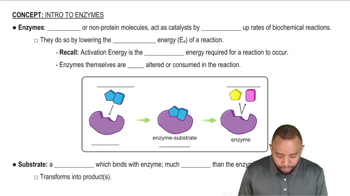
Enzyme catalysis refers to the acceleration of chemical reactions by enzymes, which are biological catalysts. Enzymes lower the activation energy required for reactions, allowing them to occur more rapidly and efficiently. Understanding how enzymes like transmethylases function is essential for grasping their role in metabolic pathways and their potential implications in health and disease.
Recommended video:
Guided course
2:14
Intro to Enzymes Concept 1