Pearson+ LogoPearson+ Logo
Ch.19 Enzymes and Vitamins
McMurry - Fundamentals of GOB 8th Edition
McMurry8th EditionFundamentals of GOBISBN: 9780134015187Not the one you use?Change textbook
Chapter 19, Problem 42c

What classes of enzymes would you expect to catalyze the following reactions?
c. Chemical reaction showing the conversion of two aldehyde molecules into an alkene with hydroxyl groups.

Verified step by step guidance
1
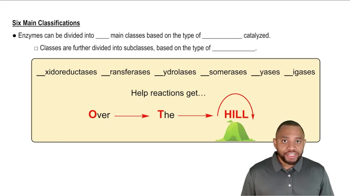
Step 1: Understand the six major classes of enzymes. Enzymes are categorized into six main classes based on the type of reaction they catalyze: (1) Oxidoreductases, (2) Transferases, (3) Hydrolases, (4) Lyases, (5) Isomerases, and (6) Ligases. Each class corresponds to a specific type of chemical transformation.
Step 2: Analyze the reaction provided in the image. Look at the reactants and products to determine the type of chemical change occurring. For example, is there a transfer of functional groups, a breaking of bonds with water, or a rearrangement of atoms?
Step 3: Match the reaction type to the enzyme class. For example: (a) If the reaction involves oxidation or reduction, the enzyme is likely an oxidoreductase. (b) If a functional group is transferred from one molecule to another, the enzyme is likely a transferase. (c) If bonds are broken using water, the enzyme is likely a hydrolase.
Step 4: Consider any additional clues in the reaction. For example, if the reaction involves the addition or removal of groups to form double bonds, the enzyme is likely a lyase. If the reaction involves rearranging atoms within a molecule, it is likely an isomerase. If two molecules are joined together, the enzyme is likely a ligase.
Step 5: Assign the enzyme class based on your analysis. Once you have identified the type of reaction, assign the appropriate enzyme class from the six categories. Ensure that your reasoning aligns with the observed chemical transformation in the reaction.

Verified video answer for a similar problem:

This video solution was recommended by our tutors as helpful for the problem above.
Video duration:
1m
Was this helpful?

Key Concepts

Here are the essential concepts you must grasp in order to answer the question correctly.

Enzyme Classification

Enzymes are classified into six main categories based on the type of reaction they catalyze: oxidoreductases, transferases, hydrolases, lyases, isomerases, and ligases. Understanding these classes helps in predicting which enzymes might be involved in specific biochemical reactions, as each class has distinct functions and mechanisms.
Recommended video:
Guided course
1:26
Six Main Classifications Concept 3

Catalysis Mechanism

Catalysis refers to the process by which enzymes accelerate chemical reactions. Each enzyme has a unique active site that binds to substrates, lowering the activation energy required for the reaction. Familiarity with the mechanisms of enzyme action, such as lock-and-key or induced fit models, is essential for predicting enzyme behavior in various reactions.
Recommended video:
Guided course
2:54
Intro to Lipid Digestion Concept 1

Reaction Specificity

Enzymes exhibit specificity for their substrates, meaning they catalyze particular reactions with specific molecules. This specificity is determined by the enzyme's structure and the nature of the substrate. Understanding the relationship between enzyme structure and function is crucial for identifying which enzymes would catalyze a given reaction.
Recommended video:
Guided course
01:37
Specific Gravity