Pearson+ LogoPearson+ Logo
Ch.20 Carbohydrates
McMurry - Fundamentals of GOB 8th Edition
McMurry8th EditionFundamentals of GOBISBN: 9780134015187Not the one you use?Change textbook
Chapter 20, Problem 8

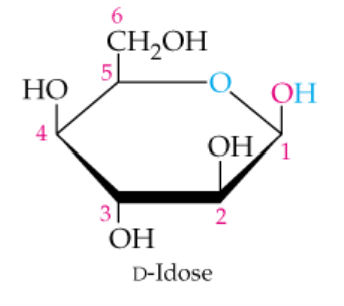
The cyclic structure of D-idose, an aldohexose, is shown in the margin. Convert this to the straight-chain Fischer projection structure.
Cyclic structure of D-idose, an aldohexose, labeled with hydroxyl groups and carbon positions.

Verified step by step guidance
1
Identify the cyclic structure as a pyranose (six-membered ring) or furanose (five-membered ring). For d-idose, it is typically a pyranose structure.
Determine the configuration of the anomeric carbon (C-1) in the cyclic structure. If the hydroxyl group (-OH) on C-1 is pointing down, it is the alpha-anomer; if it is pointing up, it is the beta-anomer.
Examine the positions of the hydroxyl groups (-OH) on the remaining carbons (C-2 to C-5) in the cyclic structure. Note whether each -OH group is pointing up or down relative to the ring plane.
Translate the positions of the -OH groups from the cyclic structure to the straight-chain Fischer projection. In the Fischer projection, groups pointing down in the cyclic structure correspond to groups on the right side of the Fischer projection, and groups pointing up correspond to groups on the left side.
Draw the Fischer projection for d-idose, ensuring that the aldehyde group (-CHO) is at the top (C-1) and the hydroxymethyl group (-CH2OH) is at the bottom (C-6). Place the -OH groups on the appropriate sides based on the configuration determined in the previous step.

Verified video answer for a similar problem:

This video solution was recommended by our tutors as helpful for the problem above.
Video duration:
1m
Was this helpful?

Key Concepts

Here are the essential concepts you must grasp in order to answer the question correctly.

Cyclic and Straight-Chain Forms of Sugars

Sugars can exist in cyclic and straight-chain forms. In aqueous solutions, many monosaccharides, like d-idose, predominantly adopt a cyclic structure due to the reaction between the carbonyl group and a hydroxyl group. The straight-chain form, known as the Fischer projection, represents the sugar in its open-chain state, which is essential for understanding its reactivity and properties.
Recommended video:
Guided course
2:55
Cyclic Hemiacetals Concept 2

Fischer Projection

The Fischer projection is a two-dimensional representation of a molecule, particularly useful for depicting carbohydrates. In this format, the most oxidized carbon is placed at the top, and the horizontal lines represent bonds that project out of the plane towards the viewer, while vertical lines represent bonds going behind the plane. This method helps visualize the stereochemistry of sugars and their functional groups.
Recommended video:
Guided course
0:48
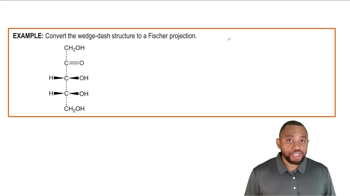
Fischer Projections Example 1

Aldoses and Ketoses

Aldoses and ketoses are two classes of monosaccharides distinguished by the position of their carbonyl group. Aldoses, like d-idose, have an aldehyde group at one end, while ketoses have a ketone group typically at the second carbon. Understanding this distinction is crucial for converting between cyclic and straight-chain forms, as it influences the structure and reactivity of the sugar.
Recommended video:
Guided course
1:03
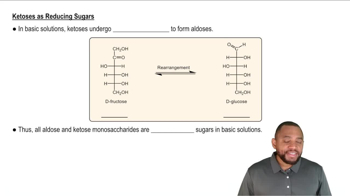
Ketoses as Reducing Sugars Concept 2