
Textbook Question
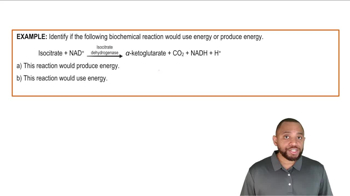
What energy requirements must be met in order for a reaction to be favorable?
810
views

 Verified step by step guidance
 3:10
3:10
 1:08
1:08 01:53
01:53What energy requirements must be met in order for a reaction to be favorable?
The reaction that follows is catalyzed by isocitrate dehydrogenase and occurs in two steps, the first of which (step A) is formation of an unstable intermediates (shown in brackets).
d. To what class of enzymes does isocitrate dehydrogenase, the enzyme that catalyzes this reaction, belong?
The following reactions occur during the catabolism of acetyl-CoA. Which are exergonic? Which is endergonic? Which reaction produces a phosphate that later yields energy by giving up a phosphate group?
c. L-Malate + NAD+ → Oxaloacetate + NADH + H+
∆G = +17 kcal/mol (+129.3 kJ/mol)
Why is ∆G a useful quantity for predicting the favorability of biochemical reactions?
The reaction that follows is catalyzed by isocitrate dehydrogenase and occurs in two steps, the first of which (step A) is formation of an unstable intermediates (shown in brackets).
b. In which step is CO2 evolved and a hydrogen ion added?
The reaction that follows is catalyzed by isocitrate dehydrogenase and occurs in two steps, the first of which (step A) is formation of an unstable intermediates (shown in brackets).
c. Which of the structures shown can be described as a β-keto acid?