Pearson+ LogoPearson+ Logo
Ch.21 The Generation of Biochemical Energy
McMurry - Fundamentals of GOB 8th Edition
McMurry8th EditionFundamentals of GOBISBN: 9780134015187Not the one you use?Change textbook
Chapter 21, Problem 31c

The following reactions occur during the catabolism of acetyl-CoA. Which are exergonic? Which is endergonic? Which reaction produces a phosphate that later yields energy by giving up a phosphate group?
c. L-Malate + NAD+ → Oxaloacetate + NADH + H+
G = +17 kcal/mol (+129.3 kJ/mol)

Verified step by step guidance
1
Step 1: Understand the terms 'exergonic' and 'endergonic'. Exergonic reactions release energy and have a negative ΔG value, while endergonic reactions require energy input and have a positive ΔG value.
Step 2: Analyze the given reaction: L-Malate + NAD⁺ → Oxaloacetate + NADH + H⁺. The ΔG value is provided as +17 kcal/mol (+129.3 kJ/mol). Since the ΔG is positive, this reaction is endergonic, meaning it requires energy input to proceed.
Step 3: Identify whether the reaction produces a phosphate group. In this reaction, there is no mention of a phosphate group being produced or transferred. Therefore, this reaction does not directly produce a phosphate that later yields energy.
Step 4: Compare this reaction to other reactions in the catabolism of acetyl-CoA. Reactions that produce high-energy intermediates like ATP or GTP typically involve the transfer of phosphate groups, which is not the case here.
Step 5: Conclude that this reaction is endergonic due to its positive ΔG value and does not produce a phosphate group that later yields energy.

Verified video answer for a similar problem:

This video solution was recommended by our tutors as helpful for the problem above.
Video duration:
2m
Was this helpful?

Key Concepts

Here are the essential concepts you must grasp in order to answer the question correctly.

Exergonic and Endergonic Reactions

Exergonic reactions are those that release energy, typically characterized by a negative change in Gibbs free energy (∆G < 0). In contrast, endergonic reactions require an input of energy to proceed, indicated by a positive change in Gibbs free energy (∆G > 0). Understanding these concepts is crucial for analyzing metabolic pathways, as they dictate the direction and feasibility of biochemical reactions.
Recommended video:
Guided course
1:30
Alcohol Reactions: Dehydration Reactions Concept 1

Gibbs Free Energy (∆G)

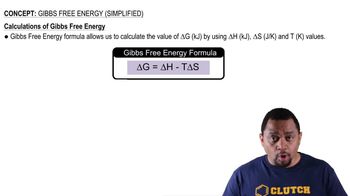
Gibbs free energy is a thermodynamic potential that helps predict the direction of chemical reactions. It combines the system's enthalpy and entropy to determine whether a reaction can occur spontaneously. A negative ∆G indicates a spontaneous process, while a positive ∆G suggests that the reaction is non-spontaneous and requires energy input, which is essential for evaluating the reactions in the catabolism of acetyl-CoA.
Recommended video:
Guided course
01:04
Gibbs Free Energy (Simplified) Concept 3

Phosphorylation and Energy Transfer

Phosphorylation is the addition of a phosphate group to a molecule, often resulting in energy transfer. In metabolic pathways, certain reactions produce high-energy phosphate compounds, which can later release energy by transferring their phosphate group to other molecules. This process is vital for cellular energy metabolism, as it allows the cell to harness energy from catabolic reactions for various biological functions.
Recommended video:
Guided course
1:23
Oxidative Phosphorylation Example 1