Pearson+ LogoPearson+ Logo
Ch.21 The Generation of Biochemical Energy
McMurry - Fundamentals of GOB 8th Edition
McMurry8th EditionFundamentals of GOBISBN: 9780134015187Not the one you use?Change textbook
Chapter 21, Problem 54

What is the final fate of the carbons in acetyl-CoA after several turns of the citric acid cycle?

Verified step by step guidance
1
Understand that acetyl-CoA is a two-carbon molecule that enters the citric acid cycle (also known as the Krebs cycle or TCA cycle). Its carbons are eventually oxidized to carbon dioxide (CO₂).
In the first step of the citric acid cycle, acetyl-CoA combines with a four-carbon molecule, oxaloacetate, to form a six-carbon molecule, citrate. This is catalyzed by the enzyme citrate synthase.
As the cycle progresses, citrate undergoes a series of enzymatic reactions, including isomerization, decarboxylation, and oxidation. During two specific decarboxylation steps, two molecules of CO₂ are released. These CO₂ molecules originate from the carbons of the acetyl-CoA that entered the cycle.
The remaining intermediates in the cycle are regenerated back to oxaloacetate, which can combine with another acetyl-CoA to repeat the cycle. This ensures the continuous processing of acetyl-CoA carbons into CO₂.
Thus, the final fate of the carbons in acetyl-CoA is their complete oxidation to CO₂, which is then released as a waste product during cellular respiration.

Verified video answer for a similar problem:

This video solution was recommended by our tutors as helpful for the problem above.
Video duration:
3m
Was this helpful?

Key Concepts

Here are the essential concepts you must grasp in order to answer the question correctly.

Acetyl-CoA

Acetyl-CoA is a central metabolite in cellular respiration, formed from carbohydrates, fats, and proteins. It serves as a key substrate for the citric acid cycle (Krebs cycle), where it combines with oxaloacetate to form citrate, initiating a series of reactions that ultimately lead to energy production.
Recommended video:
Guided course
1:33
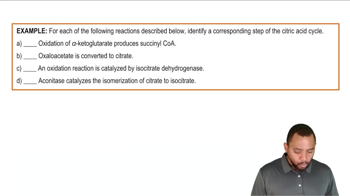
Phase B - Succinyl CoA Formation Example 2

Citric Acid Cycle

The citric acid cycle is a series of enzymatic reactions that occur in the mitochondria, where acetyl-CoA is oxidized to produce energy. During the cycle, carbon atoms from acetyl-CoA are released as carbon dioxide (CO2), and high-energy electron carriers, such as NADH and FADH2, are generated, which are crucial for ATP production in the electron transport chain.
Recommended video:
Guided course
2:31
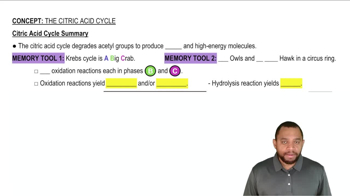
Citric Acid Cycle Summary Concept 12

Carbon Fate

The fate of carbon atoms in acetyl-CoA during the citric acid cycle involves their conversion into carbon dioxide (CO2) through decarboxylation reactions. This process not only contributes to the release of energy but also plays a vital role in the overall carbon balance in cellular metabolism, as CO2 is expelled as a waste product during respiration.
Recommended video:
Guided course
2:41
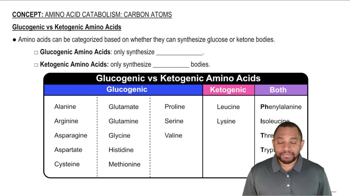
Amino Acid Catabolism: Carbon Atoms Concept 1