Pearson+ LogoPearson+ Logo
Ch.21 The Generation of Biochemical Energy
McMurry - Fundamentals of GOB 8th Edition
McMurry8th EditionFundamentals of GOBISBN: 9780134015187Not the one you use?Change textbook
Chapter 21, Problem 52

Where in the cell does the citric acid cycle take place?

Verified step by step guidance
1
Understand that the citric acid cycle, also known as the Krebs cycle or TCA cycle, is a key metabolic pathway involved in cellular respiration.
Recall that cellular respiration occurs in eukaryotic cells, which have specialized organelles called mitochondria.
Identify that the citric acid cycle specifically takes place in the mitochondrial matrix, which is the innermost compartment of the mitochondria.
Note that the mitochondrial matrix contains the enzymes and molecules necessary for the reactions of the citric acid cycle to occur.
Recognize that the citric acid cycle is crucial for generating high-energy molecules like NADH and FADH₂, which are used in the electron transport chain to produce ATP.

Verified video answer for a similar problem:

This video solution was recommended by our tutors as helpful for the problem above.
Video duration:
39s
Was this helpful?

Key Concepts

Here are the essential concepts you must grasp in order to answer the question correctly.

Citric Acid Cycle

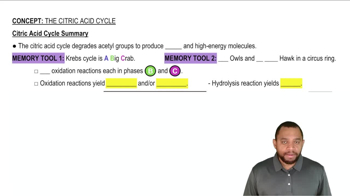
The citric acid cycle, also known as the Krebs cycle or TCA cycle, is a series of chemical reactions used by all aerobic organisms to generate energy. It involves the oxidation of acetyl-CoA derived from carbohydrates, fats, and proteins into carbon dioxide and water, while producing ATP, NADH, and FADH2, which are crucial for cellular energy.
Recommended video:
Guided course
2:31
Citric Acid Cycle Summary Concept 12

Mitochondria

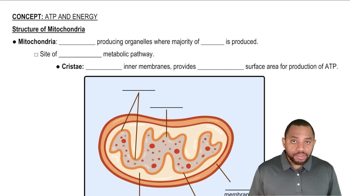
Mitochondria are membrane-bound organelles found in the cytoplasm of eukaryotic cells, often referred to as the 'powerhouses' of the cell. They are the primary site for the citric acid cycle, where the cycle occurs in the mitochondrial matrix, allowing for efficient energy production through aerobic respiration.
Recommended video:
Guided course
1:46
Structure of Mitochondria Concept 1

Aerobic Respiration

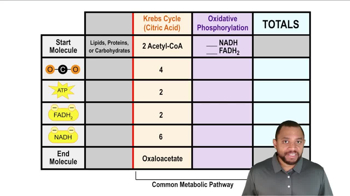
Aerobic respiration is a metabolic process that requires oxygen to convert biochemical energy from nutrients into ATP. The citric acid cycle is a key component of this process, as it not only produces energy carriers but also provides intermediates for various biosynthetic pathways, highlighting its importance in cellular metabolism.
Recommended video:
Guided course
2:46
Aerobic Respiration Summary Concept 1