
Pearson+ LogoPearson+ Logo
Ch.23 Lipids
McMurry - Fundamentals of GOB 8th Edition
McMurry8th EditionFundamentals of GOBISBN: 9780134015187Not the one you use?Change textbook
Chapter 23, Problem 22

Complete hydrogenation of triacylglycerol C in Problem 23.20 yields a triacylglycerol of what fatty acid composition? Would the hydrogenation product of triacylglycerol C be more like the hydrogenation product of triacylglycerol A or B? Explain.

Verified step by step guidance
1
Step 1: Understand the process of hydrogenation. Hydrogenation is a chemical reaction where hydrogen (H₂) is added to unsaturated bonds (double bonds) in fatty acids, converting them into saturated bonds (single bonds). This process typically uses a catalyst such as nickel or platinum.
Step 2: Analyze the structure of triacylglycerol C. Triacylglycerols are composed of a glycerol backbone esterified to three fatty acid chains. Identify the degree of unsaturation (number of double bonds) in the fatty acid chains of triacylglycerol C from Problem 23.20.
Step 3: Predict the product of complete hydrogenation. During complete hydrogenation, all double bonds in the fatty acid chains of triacylglycerol C are converted into single bonds, resulting in fully saturated fatty acids. Write the chemical structure of the fully saturated triacylglycerol.
Step 4: Compare the hydrogenation product of triacylglycerol C with those of triacylglycerols A and B. Determine whether the fatty acid composition of the hydrogenation product of triacylglycerol C is more similar to that of A or B by comparing the number of saturated fatty acids in each product.
Step 5: Explain the similarity. If the hydrogenation product of triacylglycerol C has a similar degree of saturation and fatty acid composition to either A or B, explain why this is the case based on the original unsaturation levels of the triacylglycerols before hydrogenation.

Verified video answer for a similar problem:

This video solution was recommended by our tutors as helpful for the problem above.
Video duration:
6m
Was this helpful?

Key Concepts

Here are the essential concepts you must grasp in order to answer the question correctly.

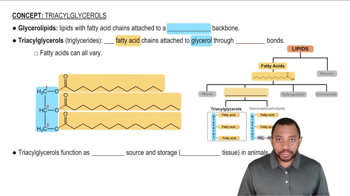
Triacylglycerol Structure

Triacylglycerols (TAGs) are esters formed from glycerol and three fatty acids. The specific fatty acid composition of a triacylglycerol influences its physical properties, such as melting point and stability. Understanding the structure of TAGs is essential for predicting the outcomes of chemical reactions like hydrogenation.
Recommended video:
Guided course
1:52
Triacylglycerols Concept 1

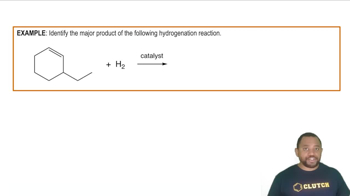
Hydrogenation Process

Hydrogenation is a chemical reaction that involves the addition of hydrogen to unsaturated fatty acids, converting them into saturated fatty acids. This process alters the physical properties of fats, typically increasing their melting point and stability. Knowing how hydrogenation affects fatty acid composition is crucial for determining the final product of triacylglycerol C.
Recommended video:
Guided course
0:49
Hydrogenation Reactions Example 1

Comparative Analysis of Triacylglycerols

Comparative analysis involves evaluating the differences and similarities between various triacylglycerols based on their fatty acid profiles. By comparing the hydrogenation products of triacylglycerols A, B, and C, one can infer which product is more similar based on the degree of saturation and the types of fatty acids present. This analysis is key to answering the question regarding the hydrogenation product of triacylglycerol C.
Recommended video:
Guided course
1:52
Triacylglycerols Concept 1