Complete hydrogenation of triacylglycerol C in Problem 23.20 yields a triacylglycerol of what fatty acid composition? Would the hydrogenation product of triacylglycerol C be more like the hydrogenation product of triacylglycerol A or B? Explain.
Ch.23 Lipids
Chapter 23, Problem 29
Draw an 18-carbon unsaturated fatty acid that contains two carbon–carbon double bonds, one on carbon 6 and one on carbon 9 (count starting with the carboxyl carbon). Is this a “straight-chain” molecule or a “bent” molecule?
Verified step by step guidance1
Step 1: Begin by understanding the structure of a fatty acid. A fatty acid consists of a carboxyl group (-COOH) at one end and a long hydrocarbon chain. In this case, the chain contains 18 carbons.
Step 2: Identify the positions of the double bonds. The problem specifies that there are two carbon–carbon double bonds: one at carbon 6 and one at carbon 9. Number the carbon atoms starting from the carboxyl carbon (carbon 1).
Step 3: Draw the hydrocarbon chain with single bonds between carbons initially. Then, introduce the double bonds at the specified positions: between carbon 6 and carbon 7, and between carbon 9 and carbon 10. Ensure the rest of the carbons are connected by single bonds.
Step 4: Determine the geometry around the double bonds. Carbon–carbon double bonds in fatty acids typically have a cis configuration, which causes a bend in the molecule at each double bond. Draw the chain with bends at the positions of the double bonds to reflect this geometry.
Step 5: Conclude whether the molecule is 'straight-chain' or 'bent.' Since the cis double bonds introduce bends in the structure, this molecule is not a straight-chain molecule but a bent one.

Verified video answer for a similar problem:
This video solution was recommended by our tutors as helpful for the problem above.
Video duration:
3mWas this helpful?
Key Concepts
Here are the essential concepts you must grasp in order to answer the question correctly.
Fatty Acid Structure
Fatty acids are carboxylic acids with long hydrocarbon chains. The structure includes a carboxyl group (-COOH) at one end, followed by a chain of carbon atoms. In unsaturated fatty acids, one or more double bonds exist between carbon atoms, affecting the molecule's shape and properties.
Recommended video:
Guided course
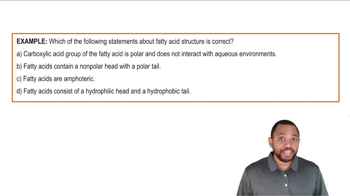
Fatty Acids Example 1
Unsaturation and Double Bonds
Unsaturation refers to the presence of double bonds in a fatty acid chain. Each double bond introduces a kink in the chain, preventing tight packing of the molecules. In this case, the presence of two double bonds at specific positions (carbon 6 and carbon 9) indicates that the fatty acid is unsaturated and will have a bent shape.
Recommended video:
Guided course
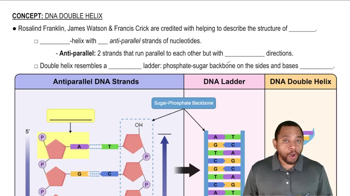
DNA Double Helix Concept 1
Molecular Geometry
Molecular geometry describes the three-dimensional arrangement of atoms in a molecule. In the case of fatty acids, the presence of double bonds leads to a bent or kinked structure, as opposed to a straight-chain configuration. This geometric difference influences the physical properties of the fatty acid, such as melting point and fluidity.
Recommended video:
Guided course
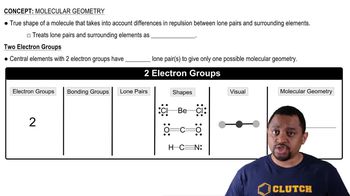
Molecular Geometry (Simplified) Concept 1
Related Practice
Textbook Question
922
views
Textbook Question
A membrane lipid was isolated and completely hydrolyzed. The following products were detected: ethanolamine, phosphate, glycerol, palmitic acid, and oleic acid. Propose a structure for this membrane lipid, and name the family to which it belongs.
761
views
Textbook Question
Draw an 18-carbon saturated fatty acid. Is this a “straight-chain” molecule or a “bent” molecule?
928
views
Textbook Question
Are the carbon–carbon double bonds in naturally occurring fatty acids primarily cis or trans?
1490
views
Textbook Question
Which of these fatty acids has the lower melting point? Explain why.
a. Linoleic acid
b. Stearic acid
541
views
Textbook Question
Which of these fatty acids has the higher melting point? Explain why.
a. Linolenic acid
b. Stearic acid
803
views