
Pearson+ LogoPearson+ Logo
Ch.23 Lipids
McMurry - Fundamentals of GOB 8th Edition
McMurry8th EditionFundamentals of GOBISBN: 9780134015187Not the one you use?Change textbook
Chapter 23, Problem 16a

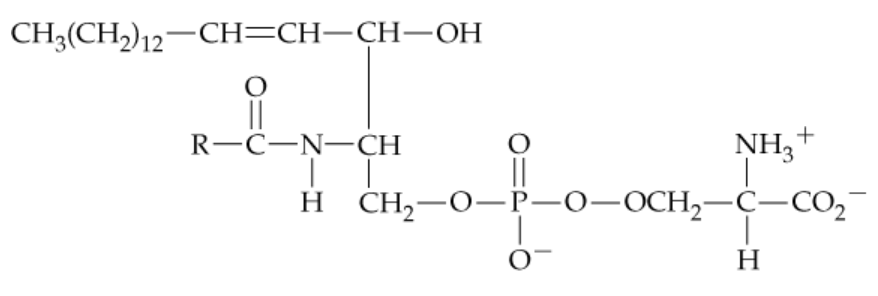
Which of the following terms apply to the compound shown below? (Hint: Look at the functional groups and the bonds involved to begin analyzing the compound part by part in comparison to the lipids discussed in this chapter.)
Chemical structure of a glycerophospholipid, showing functional groups and bonds for analysis.
a. A phospholipid

Verified step by step guidance
1
Examine the structure of the compound in the image provided. Identify the key functional groups present, such as phosphate groups, fatty acid chains, or glycerol backbones, which are characteristic of lipids.
Recall the definition of a phospholipid: a molecule that typically consists of a glycerol backbone, two fatty acid chains (hydrophobic tails), and a phosphate group attached to a polar head group (hydrophilic head).
Compare the functional groups and structural components of the compound in the image to the characteristics of a phospholipid. Look for the presence of a phosphate group and the arrangement of hydrophobic and hydrophilic regions.
Analyze the bonds involved in the compound. Phospholipids often have ester bonds linking the fatty acid chains to the glycerol backbone and a phosphoester bond connecting the phosphate group to the glycerol.
Determine if the compound matches the structural and functional criteria of a phospholipid based on your analysis. If it does, the term 'phospholipid' applies to the compound.

Verified video answer for a similar problem:

This video solution was recommended by our tutors as helpful for the problem above.
Video duration:
1m
Was this helpful?

Key Concepts

Here are the essential concepts you must grasp in order to answer the question correctly.

Functional Groups

Functional groups are specific groups of atoms within molecules that are responsible for the characteristic chemical reactions of those molecules. In the context of lipids, common functional groups include hydroxyl (-OH), carboxyl (-COOH), and phosphate (-PO4). Identifying these groups in a compound helps determine its chemical behavior and classification.
Recommended video:
Guided course
1:11
Functional Group Priorities Concept 1

Phospholipids

Phospholipids are a class of lipids that are a major component of all cell membranes. They consist of two fatty acid tails and a phosphate group attached to a glycerol backbone. The amphipathic nature of phospholipids, with hydrophilic heads and hydrophobic tails, allows them to form bilayers that are essential for membrane structure and function.
Recommended video:
Guided course
1:01
Glycerophospholipids Example 1

Comparative Analysis

Comparative analysis involves examining the similarities and differences between compounds to classify them accurately. In this case, comparing the compound in question to known lipids, particularly phospholipids, helps in identifying its functional groups and structural characteristics, leading to a better understanding of its classification.
Recommended video:
Guided course
06:11
Dimensional Analysis