
Which of the following terms apply to the compound shown below? (Hint: Look at the functional groups and the bonds involved to begin analyzing the compound part by part in comparison to the lipids discussed in this chapter.)
e. A lipid
Verified step by step guidance
Which of the following terms apply to the compound shown below? (Hint: Look at the functional groups and the bonds involved to begin analyzing the compound part by part in comparison to the lipids discussed in this chapter.)
e. A lipid
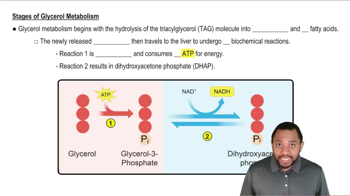
As noted earlier (Section 22.3), he first step in glycolysis, which occurs within cells, is phosphorylation of glucose to glucose 6-phosphate. Why does this step prevent passive diffusion of glucose back out of the cell?
Complete hydrogenation of triacylglycerol C in Problem 23.20 yields a triacylglycerol of what fatty acid composition? Would the hydrogenation product of triacylglycerol C be more like the hydrogenation product of triacylglycerol A or B? Explain.
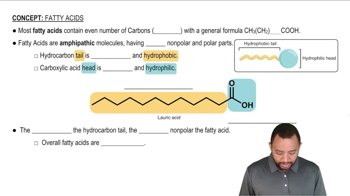
Draw an 18-carbon saturated fatty acid. Is this a “straight-chain” molecule or a “bent” molecule?
Draw an 18-carbon unsaturated fatty acid that contains two carbon–carbon double bonds, one on carbon 6 and one on carbon 9 (count starting with the carboxyl carbon). Is this a “straight-chain” molecule or a “bent” molecule?
Are the carbon–carbon double bonds in naturally occurring fatty acids primarily cis or trans?